Paraguay’s banking reckoning
Ueno’s failure has brought down a president and exposed the distance between financial inclusion and financial security. Paraguay’s response will decide whether a banking scandal becomes a lasting institutional setback.
For a household, a banking crisis begins when money that was available yesterday cannot be used today. For a government, it becomes something larger when the same institution holds public money, pays pensions and has connections to the people responsible for supervising it.
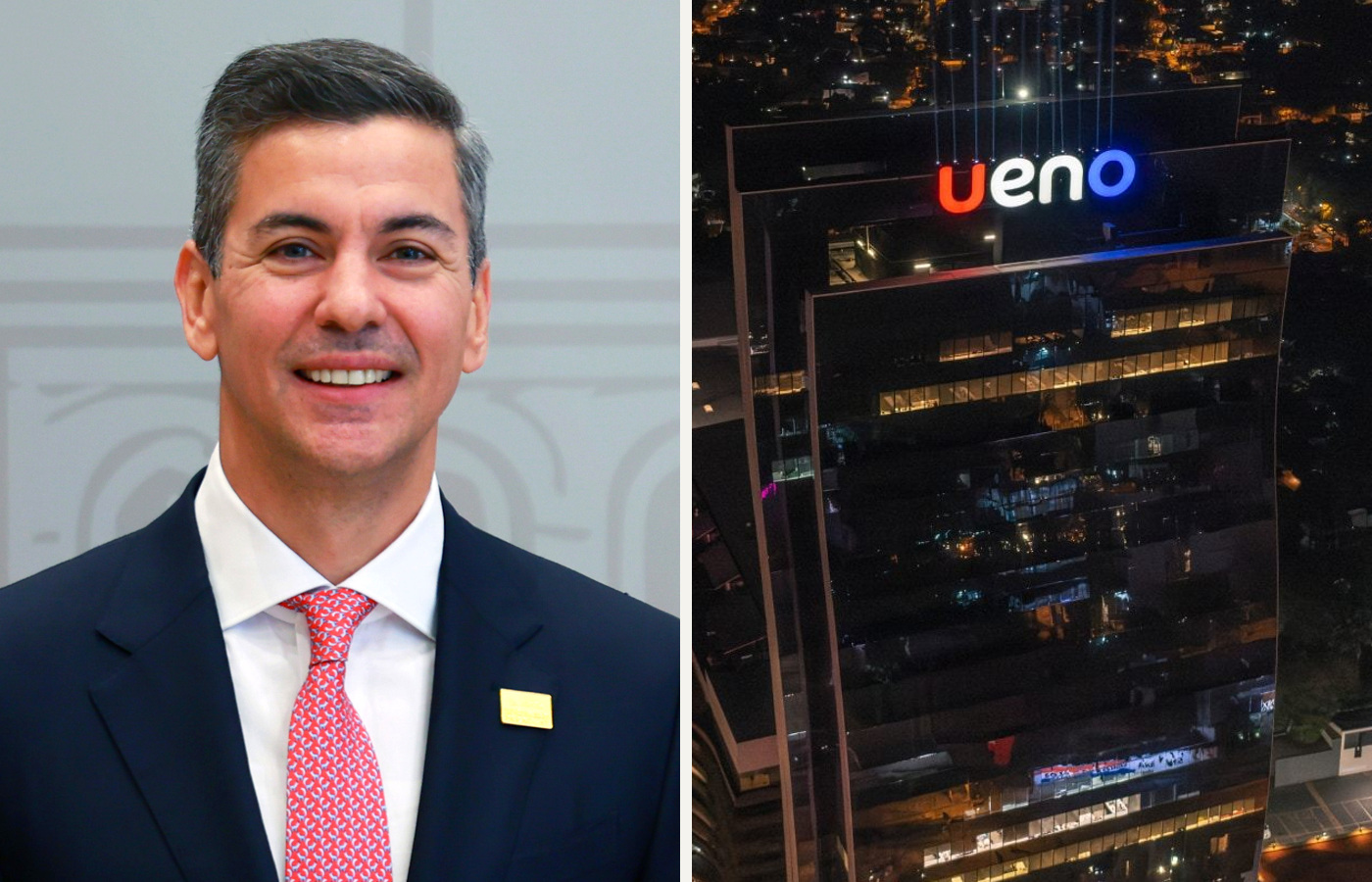
Paraguay has experienced both shocks within a week. On 3 November, the Banco Central del Paraguay, or BCP, announced that Ueno Bank was entering resolution after adjustments to its financial statements revealed a severe capital deficiency. Three days later, the Senate removed President Santiago Peña from office. Pedro Alliana, until then vice president, took over; Antonio Barrios became vice president. The new administration is due to complete the constitutional term ending on 15 August 2028.
Those events are established. The full allocation of financial losses, the extent of individual criminal responsibility and the ultimate cost to the state are not. Keeping those distinctions intact is essential to understanding a crisis in which political judgment has moved much faster than asset recovery can.
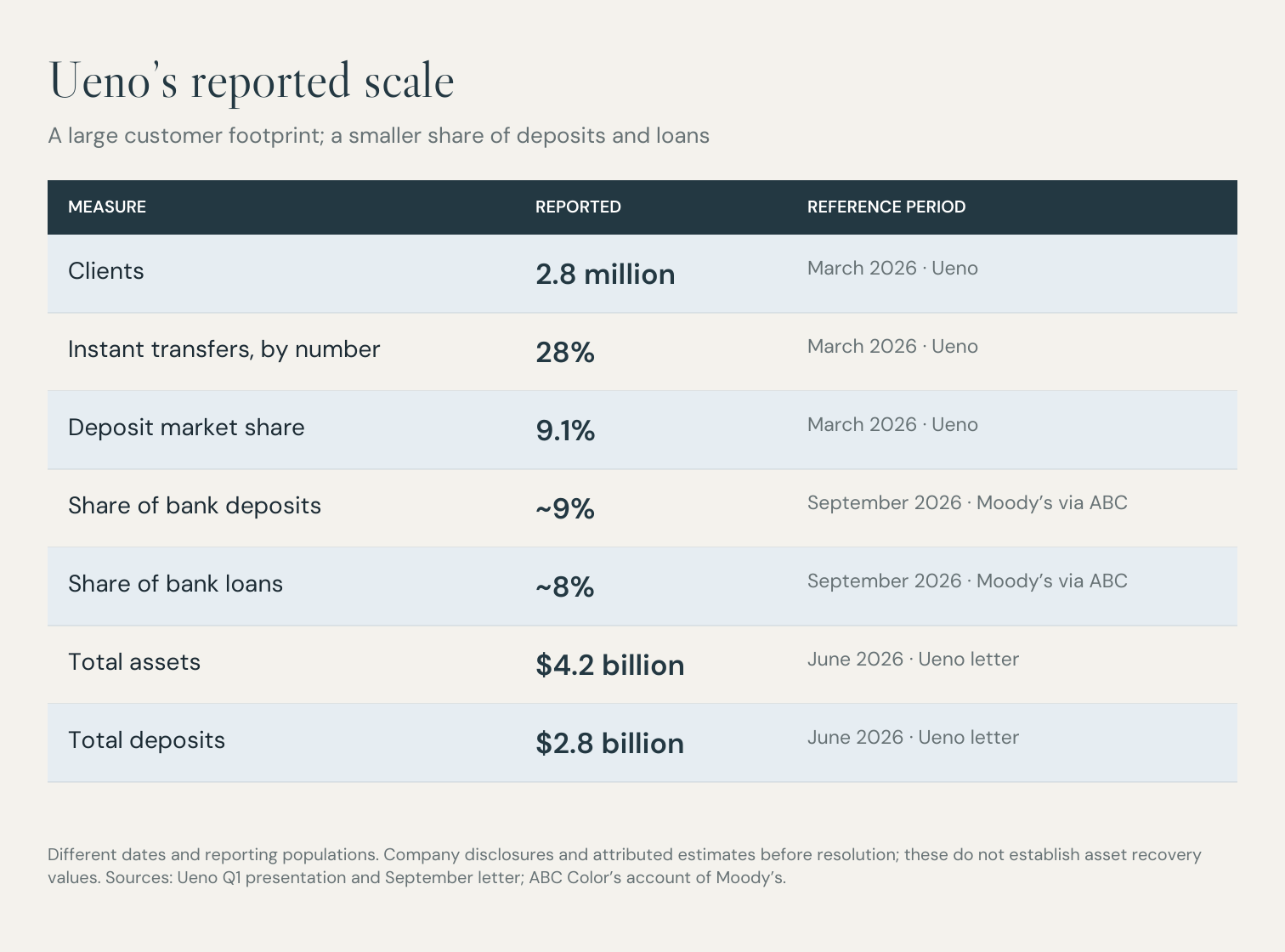
Ueno was neither a marginal app nor the custodian of most of Paraguay’s deposits. Before its resolution, it represented roughly 9% of banking-system deposits and 8% of loans, according to a Moody’s assessment reported by ABC Color. Its reach into everyday payments was substantially greater. This combination made it large enough to disrupt national life without making the failure of every other Paraguayan bank an inevitable consequence.

For Sovereign, the episode addresses a recurring question about Latin America: how should a person distinguish an attractive place to live, build a business or establish a presence from an appropriate place to concentrate liquid wealth?
Our preference for Uruguay and Panama as regional banking centers remains. It rests on the institutions, banking practices and international financial infrastructure we want to see supporting a substantial balance. It is a preference that requires qualifications, bank selection and diversification. Paraguay is regulated and has deposit insurance. Panama has significant gaps in its financial safety net. Uruguay has endured a devastating banking crisis of its own.
The argument therefore needs to be more demanding than a contest between national reputations. Ueno illustrates what happens when a successful banking proposition depends on the credibility of financial statements and supervisory decisions that depositors cannot meaningfully inspect for themselves.
Ueno’s history stretches back much further than its digital brand. The institution’s 2025 financial statements trace its incorporation as Financiera El Comercio to a public deed dated 26 April 1976. Government recognition followed in July that year. The legal predecessor was an established finance company long before the Ueno name appeared.
The modern transformation began with Grupo Vázquez’s acquisition of El Comercio in 2021. Ueno’s own 2021 annual report dates the emergence of the new identity to 20 December that year; contemporaneous material from the Paraguayan Football Association dates its public launch to 28 February 2022. Those dates describe different stages of the same transition.
The distinction matters because calling Ueno a bank founded in 2021 compresses several changes into one. A decades-old institution acquired new ownership, a new brand, a digital distribution strategy and, later, a different regulatory license.
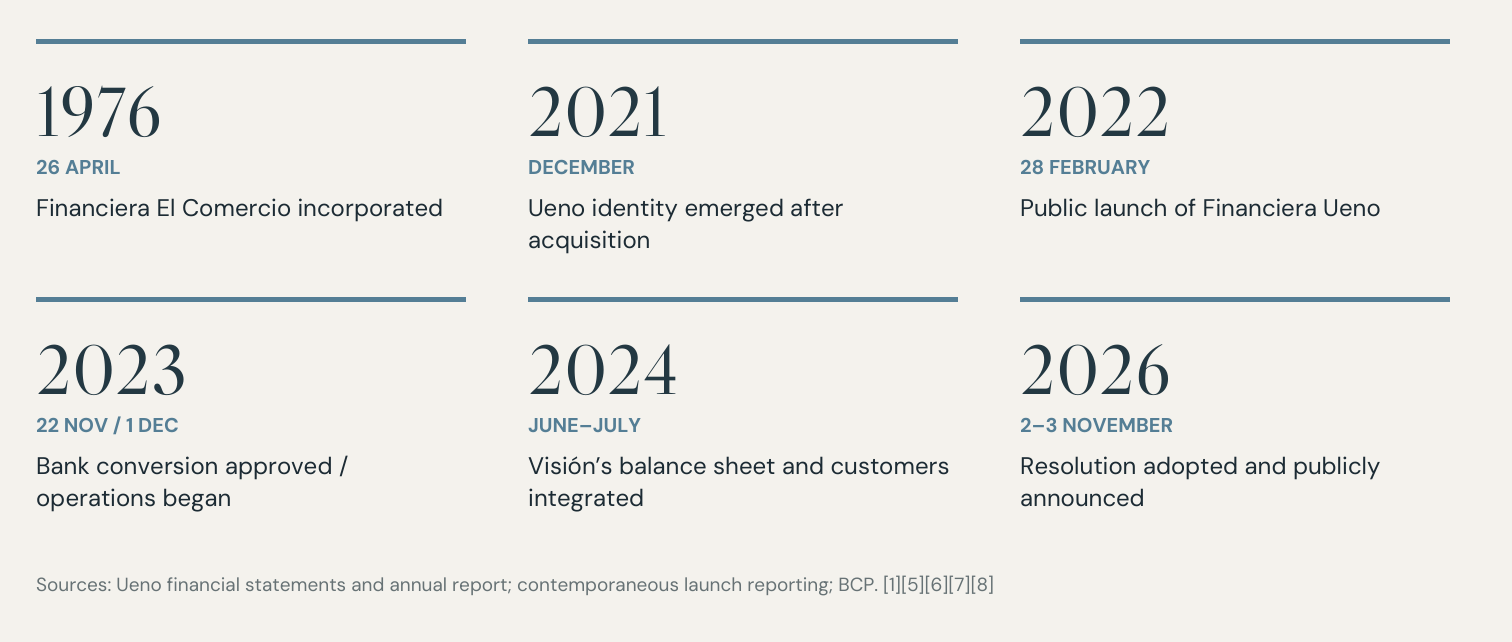
The Visión acquisition was the decisive expansion. It brought an existing banking franchise into the younger brand rather than requiring every customer relationship to be built from scratch. Financial statements record the incorporation of Visión’s assets and liabilities in late June 2024. Customers encountered the combined institution at the start of July, when the integration also generated service complaints.
There is a general lesson in this history. A bank can look new to its customers while carrying an older institution’s loan portfolio, operational systems and obligations. Its reported growth can combine genuine customer acquisition with a merger. Neither is inherently problematic, but they require different scrutiny. Organic expansion tests underwriting capacity; a merger also tests the accuracy of acquired assets, integration controls and management’s ability to understand a larger balance sheet.

Ueno’s visibility extended beyond finance. Its agreement to sponsor Paraguayan football placed the brand in a setting with enormous public familiarity. That was commercially intelligible: people who might never read a bank’s accounts would see its name repeatedly. A sponsorship can build recognition, however, without supplying evidence about loan quality or the enforceability of collateral.
By 2026 the institution also had international financial connections. Its disclosures described a $350 million international bond issue and investment associated with Hungary’s OTP Bank. Following the intervention, OTP said its $47 million investment through Ueno’s parent did not give it management or control rights. An overseas financial institution’s minority investment should not be confused with a guarantee of a local bank’s deposits.
The size of the bank depends on what is being measured. In its presentation for the first quarter of 2026, Ueno reported approximately 2.8 million clients, 9.1% of deposits, 6.9% of loans and 28% of the number of transfers through Paraguay’s instant-payment system. It also claimed 43% of issued credit cards. These were company disclosures using BCP data, not independent post-resolution valuations.
They describe a bank whose distribution and transaction footprint exceeded its balance-sheet share. A payment count measures activity. A customer count measures relationships under the reporting definition. A deposit share measures money. None is interchangeable with the others, and customers may hold accounts at several banks.
A bank with a large number of relatively small balances can create an enormous practical emergency even if it does not dominate national savings. A customer who cannot access the money for transport, groceries or medicine is affected immediately. A business awaiting payment can be damaged before it knows whether the customer’s balance is insured. A pensioner needs a functioning payment channel as well as a legally valid claim.
This is why financial inclusion changes the responsibilities of resolution authorities. Bringing people into formal banking creates benefits, but also makes the payment infrastructure more consequential. An account that is easy to open is only one part of inclusion. Access to money during institutional failure is another.
Paraguay’s banking system is broader than Ueno. A published analysis of the BCP’s September 2026 bulletin put deposits at banks and finance companies at approximately ₲195.3 trillion. Its five largest deposit takers were Continental, Itaú, Sudameris, Banco Nacional de Fomento and GNB. Together they held 66.2% of that reporting universe’s deposits. Ueno ranked sixth.
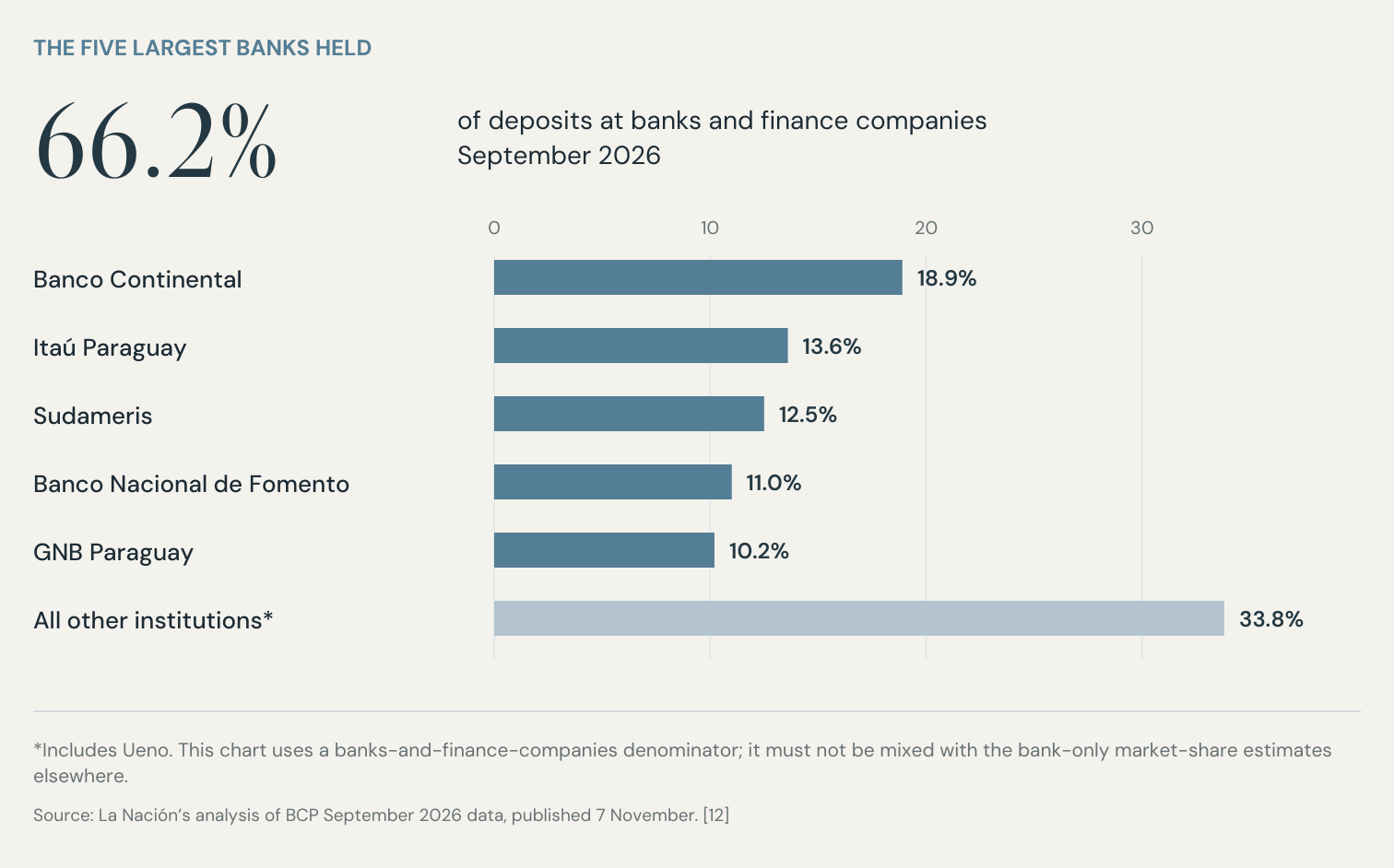
The institutions have different ownership and mandates. Itaú Paraguay belongs to the Brazilian Itaú Unibanco group. Sudameris expanded through its absorption of Banco Regional, completed in 2023. Banco Nacional de Fomento, or BNF, is a public institution; its charter separately provides a full state guarantee for accepted deposits. That guarantee is a sovereign commitment, distinct from the limited fund covering eligible deposits at private institutions.
Other participants include Atlas, Familiar, Basa, Bancop, Interfisa, Zeta and Solar, alongside operations associated with Citi, Banco do Brasil and Banco de la Nación Argentina. Their presence provides alternatives for payments, business banking and credit. It does not remove the need to assess the specific legal entity, its funding and the quality of its assets.
Concentration can help a resolution if stronger institutions can receive customers, acquire sound loans and maintain essential services. It can also increase after a failure, leaving fewer significant competitors and reducing the pressure to offer better prices or service. Paraguay therefore needs to preserve competition while finding a workable home for viable banking relationships.
The country also has a cooperative sector with a separate supervisory structure. INCOOP is the authority for cooperative entities. An account at a cooperative should not be assumed to have the same protections as an eligible deposit at a BCP-regulated private bank. Legal form is consequential even when two products are both described informally as savings.
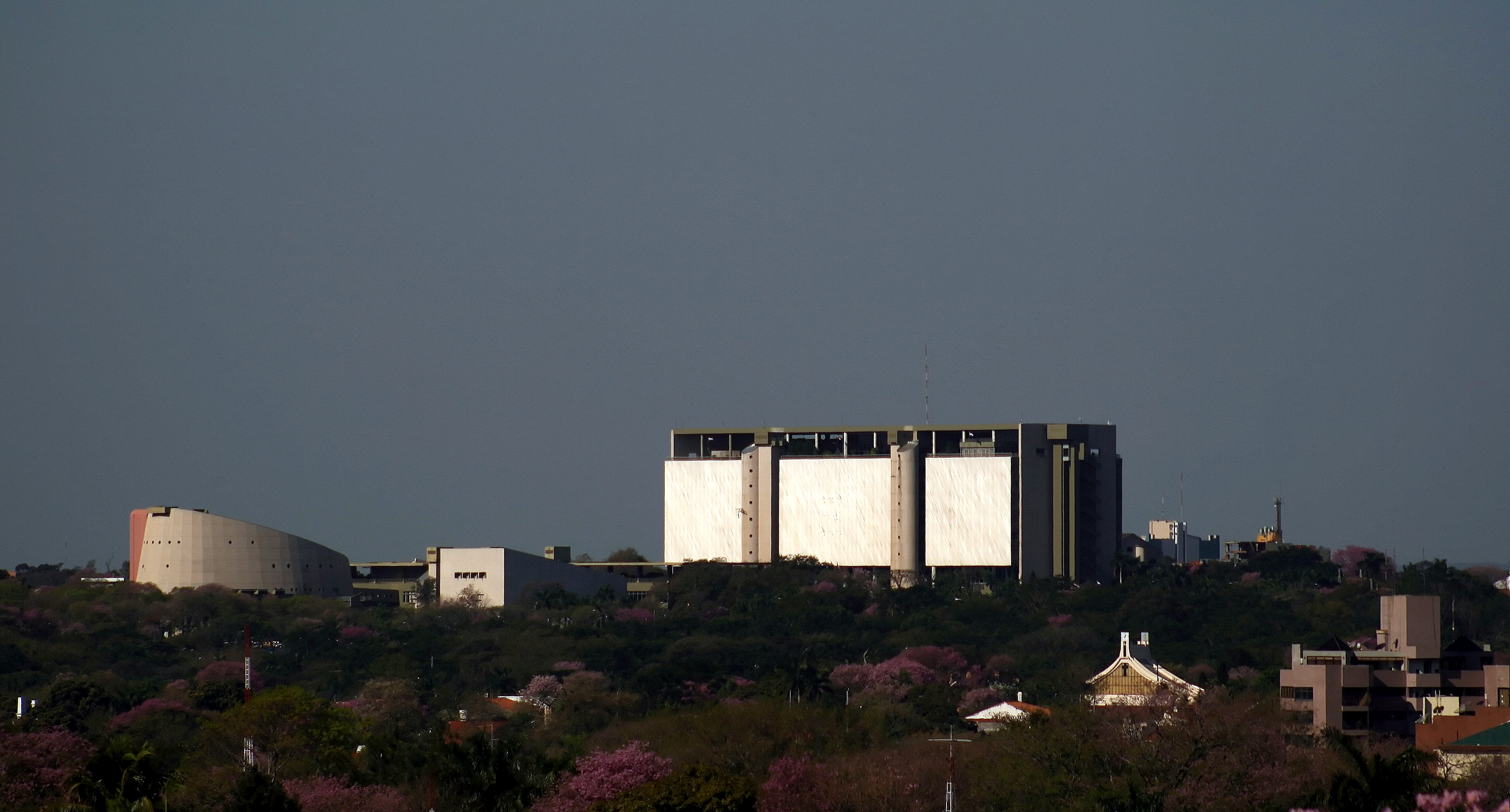
The regulatory question is about performance, not the absence of an agency. Paraguay’s Superintendencia de Bancos operates within the BCP. The banking law assigns it inspection, monitoring and examination responsibilities, including access to regulated entities’ books and records. The framework includes the general banking law, subsequent modernization legislation and the deposit-guarantee and resolution law.
The institutional structure deserves a closer look. The BCP’s governing board consists of a president and four directors, appointed by the Executive with the Senate’s prior consent. The central-bank president is consequently a powerful officeholder within a collective governing body. The law allocates particular decisions to that board and others to technical supervisors.
The banking superintendent is a separate official: the Executive appoints that person from a three-candidate shortlist presented by the BCP board. The board grants or revokes banking licenses following the superintendency’s opinion; the supervisor conducts examinations and can propose corrective measures and changes to authorizations. An inquiry into supervisory failure therefore needs to reconstruct the decisions of both the technical staff and the board.
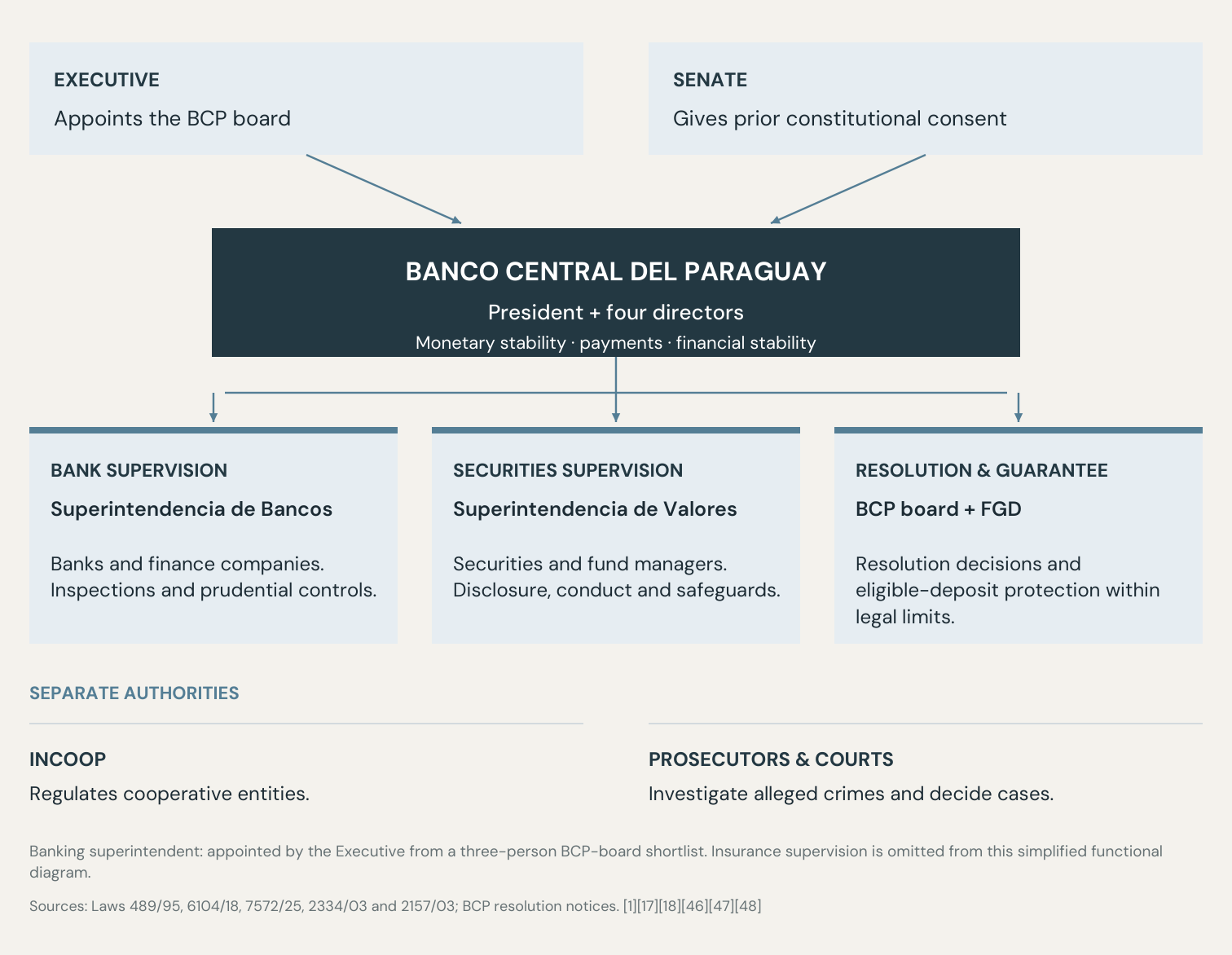
Monetary policy concerns the value and availability of money across the economy. Prudential supervision concerns whether particular institutions can meet their obligations and control their risks. A deposit guarantee compensates eligible depositors under statutory limits after a triggering event. Success in one function does not establish success in the others. Paraguay can have credible inflation management and still suffer a serious failure of bank oversight.
Investment products add another branch. Under Law 7572 of 2025, the BCP supervises the securities and products market through its Superintendencia de Valores, which has functional and administrative autonomy within the central bank. Its remit covers securities-market participants and fund managers. This is why restrictions on particular investment funds require a separate explanation from the reimbursement of an insured bank deposit.
Panama’s possession of a superintendency therefore does not, by itself, distinguish it from Paraguay. The relevant comparison concerns how effectively each system identifies connected exposures, challenges valuations, disciplines management and acts before losses become a public emergency.
Before Ueno’s failure, the aggregate Paraguayan numbers looked reassuring. The BCP’s September release reported system solvency of 16.91%, liquidity of 32.12% and nonperforming loans of 2.68%. Earlier in 2026, IMF analysis described the banking system as financially sound while warning that rapid consumer-credit expansion required vigilance.
Those statements can coexist with an institution-specific failure. An aggregate ratio averages across banks; it cannot certify every institution. Stress tests are also conditional on the accuracy of starting balance sheets and the risks they model. A test of recession, exchange rates and loan defaults may not reveal an undisclosed relationship between a lender and a borrower.
The central supervisory task is therefore partly investigative. Who ultimately controls the borrowers? Where does the money go after disbursement? Is a repayment funded by business cash flow or another loan from within the same group? Does collateral have a realizable value independent of the party providing it? A capital ratio is only as useful as the answers underlying its calculation.
The BCP’s resolution announcement gives a precise reason for intervention: adjustments during the regularization process left Ueno’s solvency index below half the required minimum. That does not mean the bank had a 50% capital ratio, or that half of deposits had necessarily disappeared. It describes a breach of a regulatory threshold after accounting adjustments. The final loss requires an asset-by-asset assessment.
The contrast with Ueno’s earlier disclosures is substantial. Its September public letter reported, for June, approximately $401 million of equity, a 14.5% total regulatory capital ratio against a 12% minimum and a 0.6% nonperforming-loan ratio. The document is evidence of what the bank represented at that time. It cannot settle what the assets were actually worth after supervisory review.
Even on 29 October, Ueno announced a $100 million capital plan: $50 million expected from its controlling shareholder and $50 million through a proposed offering to Paraguayan private investors. Completion and approvals were still ahead. The plan should not be described as $100 million of cash already available to absorb losses.
That distinction is fundamental in a fast-moving bank problem. Proposed capital can support a recovery if it arrives, is eligible and is sufficient. Announcing it does not repair an existing shortfall. Supervisors must evaluate the funds available under a credible timetable, rather than the headline size of an intended transaction.
The criminal investigation centers on how lending and related companies interacted. On 4 November, prosecutors announced charges against 27 people associated with Ueno and related businesses. Their account concerned loans and overdrafts allegedly extended on inadequate risk terms, transfers to other companies in the same group, and a roughly $74.4 million loan-portfolio transaction allegedly financed indirectly with money originating at the bank itself. These remain allegations requiring proof in court.
Among those charged was Federico Miguel Vázquez Villasanti, identified in ABC Color’s reporting as Ueno’s chief executive and first vice president. The prominence of a controlling business group’s leadership makes the investigation consequential, but it does not relieve prosecutors of proving specific conduct by each defendant.
The mechanism under investigation matters beyond this particular case. If a bank lends to an independent operating business, the repayment ultimately depends on that business generating cash or realizing assets. If it lends within a network that repeatedly recycles the same funding, separate company names can conceal a common source of repayment risk.
Similarly, selling a troubled loan does not necessarily transfer its economic risk. If the buyer is financed by the seller, and has no independent capacity to pay, the transaction may replace one weak claim with another. This is a general accounting and credit-risk concern; the investigation must establish whether and how it applies to the transactions in question.
A proper reconstruction should follow cash across the group, identify beneficial owners, test the independence of valuations and examine who approved each material exposure. It should distinguish errors of judgment, failures of control and deliberate misconduct. Those categories have different legal implications, even when each can cause losses.
The broader supervisory review must also examine the chain of assurances. Audits, ratings, investor participation and regulatory permission all influence confidence, but none is a guarantee against failure. The useful question is what information each participant had, what it verified and what it failed to challenge. Simply observing that sophisticated institutions were involved does not answer those questions.
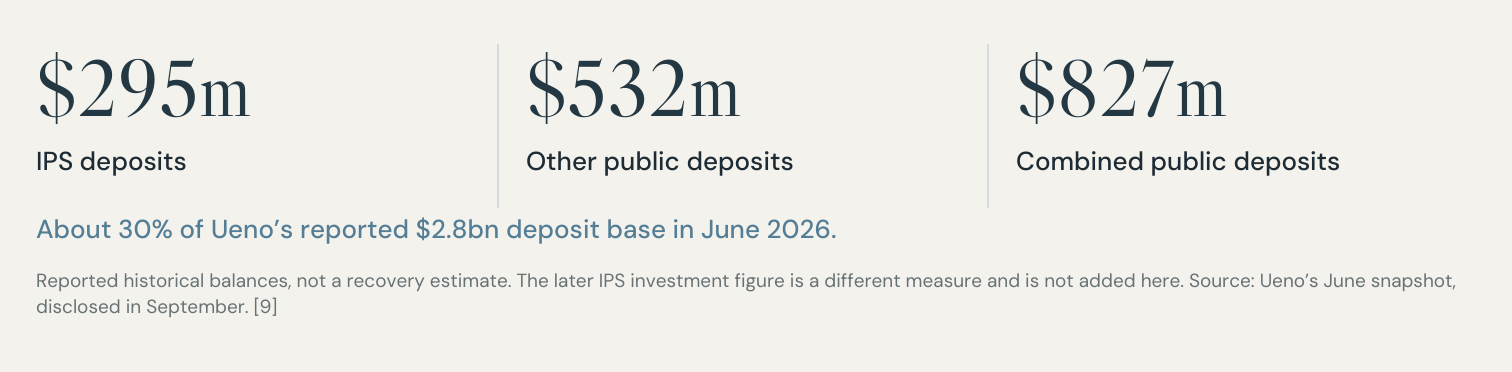
Public money is what made the bank’s distress a problem of government legitimacy. Ueno’s June snapshot, disclosed in September, identified approximately $295 million in IPS term deposits and $532 million from other public institutions. Together that is about $827 million, or roughly 30% of the bank’s stated $2.8 billion deposit base. That percentage is our calculation from the bank’s rounded figures.
The Instituto de Previsión Social, or IPS, is Paraguay’s social-security institution. EFE reported at the outbreak of the crisis that its Ueno exposure was approximately $355 million across savings certificates and financial bonds, and that the bank handled pension payments for about 32,000 retirees. The June deposit figure and the later investment figure are different in date and scope; they should not be added together.
Public-sector funding is not inherently improper. Governments and pension institutions need places to hold liquidity and invest reserves. The concern is whether placements follow independently assessed risk limits, documented selection criteria and an acceptable concentration policy. A competitive interest rate is not sufficient if an investment compromises the institution’s ability to meet essential obligations.
The timing of public decisions also matters. Investigators should establish when officials received warnings, what those warnings contained, and whether deposits were increased, renewed or left in place afterward. They should compare decisions against the information available at the time. A loss does not, by itself, prove that every earlier placement was unlawful; equally, a formal approval cannot excuse ignoring a known material risk.
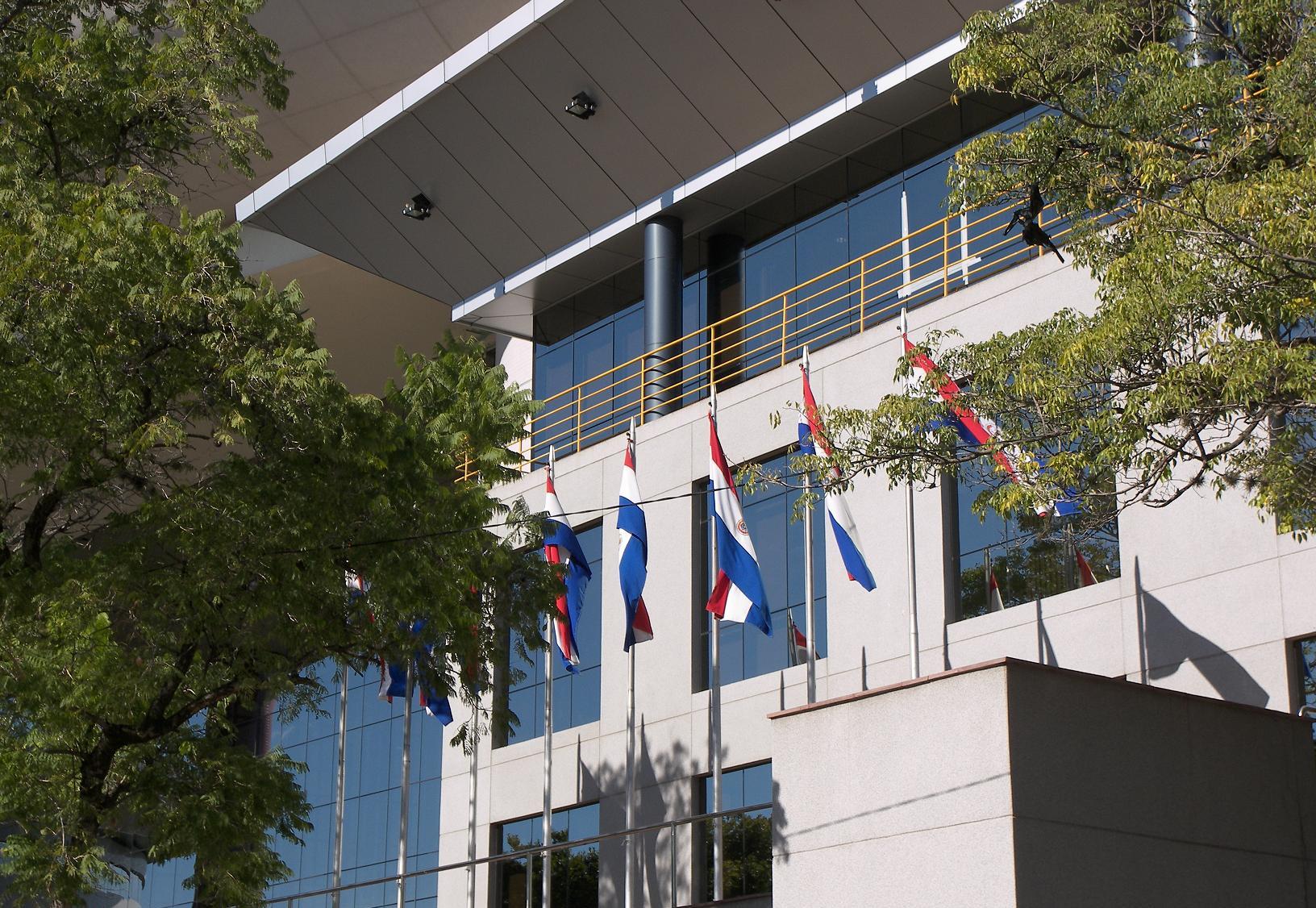
Peña’s connections made this scrutiny unavoidable. Reporting documented his former investment in the holding structure associated with Ueno and a sale in 2025. The distinction between a holding-company interest and direct bank ownership is important. Separately, Carlos Carvallo had led Financiera Ueno before becoming president of the BCP in 2023. His move placed a former executive of the institution at the head of its regulator.
The appointment record is specific. After Senate consent, Peña appointed Carlos Carvallo Spalding by Presidential Decree 214 of 31 August 2023. Carvallo assumed office on 7 September at a ceremony attended by Peña. The BCP’s own announcement emphasized inflation control, financial stability and stronger preventive supervision. That public mandate supplies an exact standard against which his tenure can be examined, without prejudging individual criminal responsibility.

Neither a previous investment nor a former job proves a criminal offense. Both create a compelling need for clear disclosure, recusal rules and independently reviewable decisions. Effective independence requires more than an assertion that officials acted impartially. It requires arrangements under which the public can understand who made the decision and which interests were excluded from it.
Peña’s attempted resignation on 5 November did not end the constitutional process. On 6 November the Senate removed him for poor performance in office. Its published account records that his lawyers disputed the procedure, challenged the identification of specific legal breaches and argued that decisions belonging to the BCP and IPS had been improperly attributed to the president. The Senate also rejected his request for a 72-hour extension to prepare his defense.
The speed of the proceeding will remain part of the political and legal debate. Accountability loses credibility if urgency becomes a substitute for process. At the same time, a constitutional removal is a political determination about fitness for office, not a criminal conviction establishing every allegation about the bank.
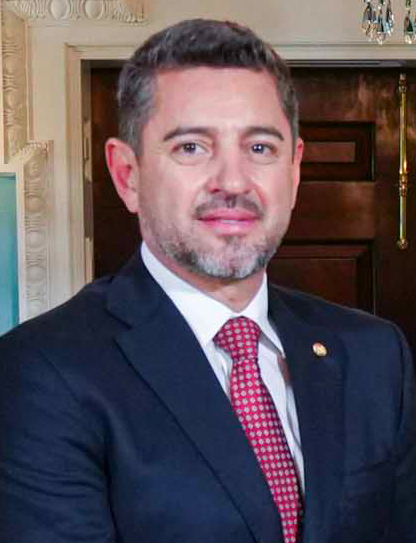
Prosecutors separately ordered Peña’s and Carvallo’s detention on 6 November. By late 7 November, ABC Color reported that a court had ordered Peña’s preventive detention in the case concerning alleged breach of trust and administration for personal benefit. He denies wrongdoing. Detention and charges do not establish guilt.
Alliana’s succession preserves the Colorado Party’s control of the presidency. Reuters describes him as a longstanding party figure and emphasizes the continuing importance of former president Horacio Cartes. A change of president therefore creates an opportunity for reform without, by itself, demonstrating a break with the political networks under scrutiny.
The new administration will be judged on decisions that are difficult for any governing party: allowing investigators access to politically sensitive records, limiting discretionary control over public deposits, and accepting findings that may implicate more than the people already removed from office.
Deposit protection is now being tested as an operational system. Paraguay’s ordinary guarantee covers eligible deposits up to 75 minimum monthly wages per depositor at each institution. At the start of this resolution, that amounted to ₲228.3 million. Accounts at the same institution are aggregated; opening several accounts does not multiply the limit. Applicable debts and statutory exclusions also matter.
The cap should be stated in guaraníes. Dollar equivalents vary with the exchange rate and can obscure the legal entitlement. A depositor also needs to identify the actual instrument held: a bank deposit, a bank-issued bond, a mutual-fund interest and a fiduciary investment are different legal claims.
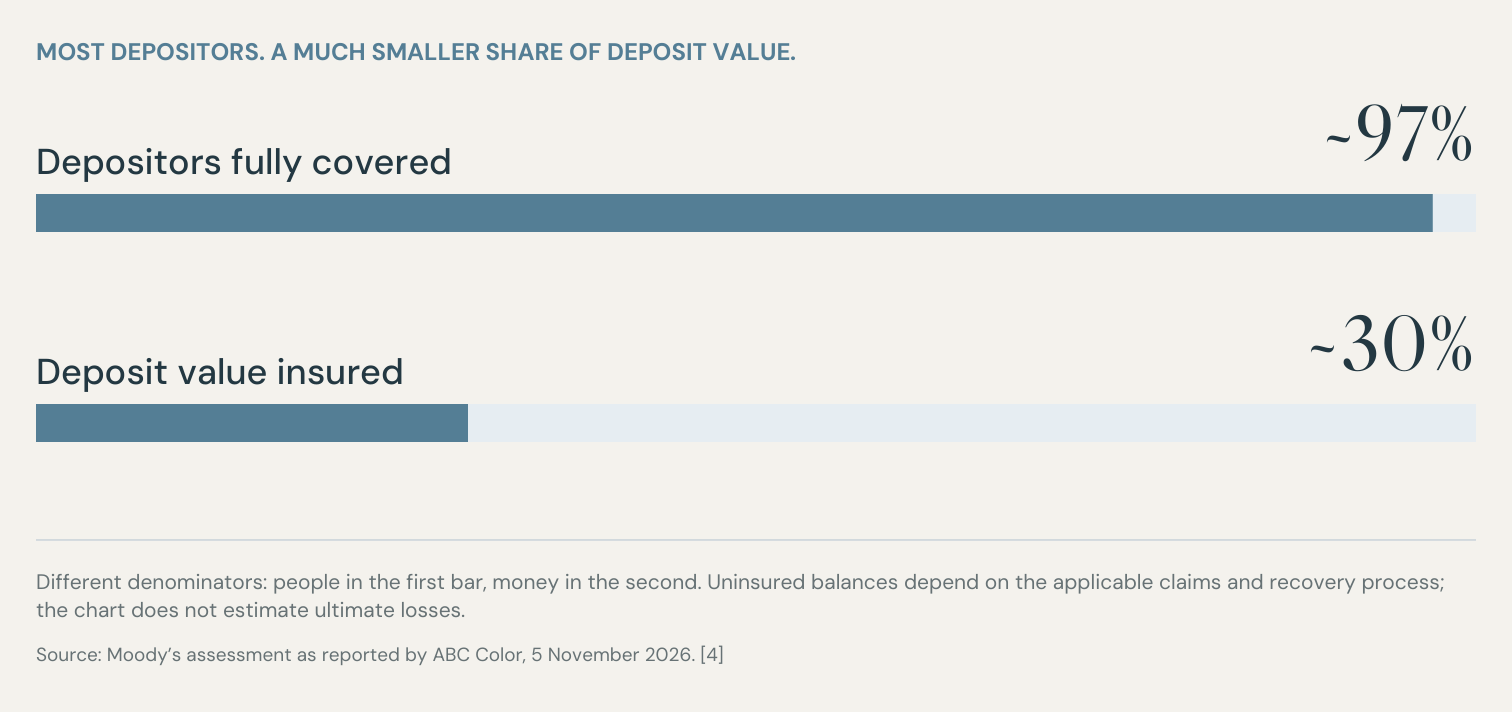
The coverage statistics require similar care. The assessment reported by ABC Color estimated that roughly 97% of Ueno depositors were fully covered, but only about 30% of the value of deposits fell within the guarantee. It also put the fund’s liquidity at approximately $1.6 billion in September, about twice Ueno’s insured deposits. Those estimates are encouraging for covered balances; they do not imply that 97% of all money will be repaid by the fund.
A large number of small accounts and a relatively small number of large accounts produce exactly this pattern. Protecting most people can still leave businesses, institutions and some households facing significant uncertainty. The recoveries on their remaining claims depend on the resolution, asset values and the applicable creditor hierarchy.
The authorities have introduced an accelerated advance of up to 40 minimum wages, equivalent to ₲121.76 million, within the guarantee framework. This is an advance against protection, not an additional sum on top of the ordinary cap. The BCP’s first payment group, announced on 5 November, covered balances up to ₲10 million for customers without debts to Ueno who had another domestic bank or finance-company account.
On 7 November, local reporting of the BCP’s briefing put beneficiaries reached at 1.196 million and disbursements at ₲996 billion. Payments were continuing through the weekend. These are progress figures at a particular point, not evidence that all claims have been settled.
There is also a route for the disruption to extend beyond depositors. The securities supervisor temporarily suspended redemptions in certain mutual funds with Ueno-linked investments while valuation rules were applied. The BCP emphasized that the measure applied to identified funds, not all funds, and that reopening would proceed individually. A fund’s legal separation from its manager does not eliminate the credit risk of the assets it owns.
That distinction should guide communication. Authorities need to explain which payment channels work, which instruments are protected, which claims remain unresolved and what information is needed from each customer. Broad reassurance becomes less useful when people cannot identify which category they belong to.
What happens next will determine the country’s economic cost. Paraguay entered the crisis with meaningful achievements. IMF reporting in 2026 highlighted macroeconomic stability, stronger external buffers and investment-grade upgrades from Moody’s in 2024 and S&P in 2025. It also identified a comprehensive financial-sector assessment planned for 2027. Those gains and that work program give the country something to protect.
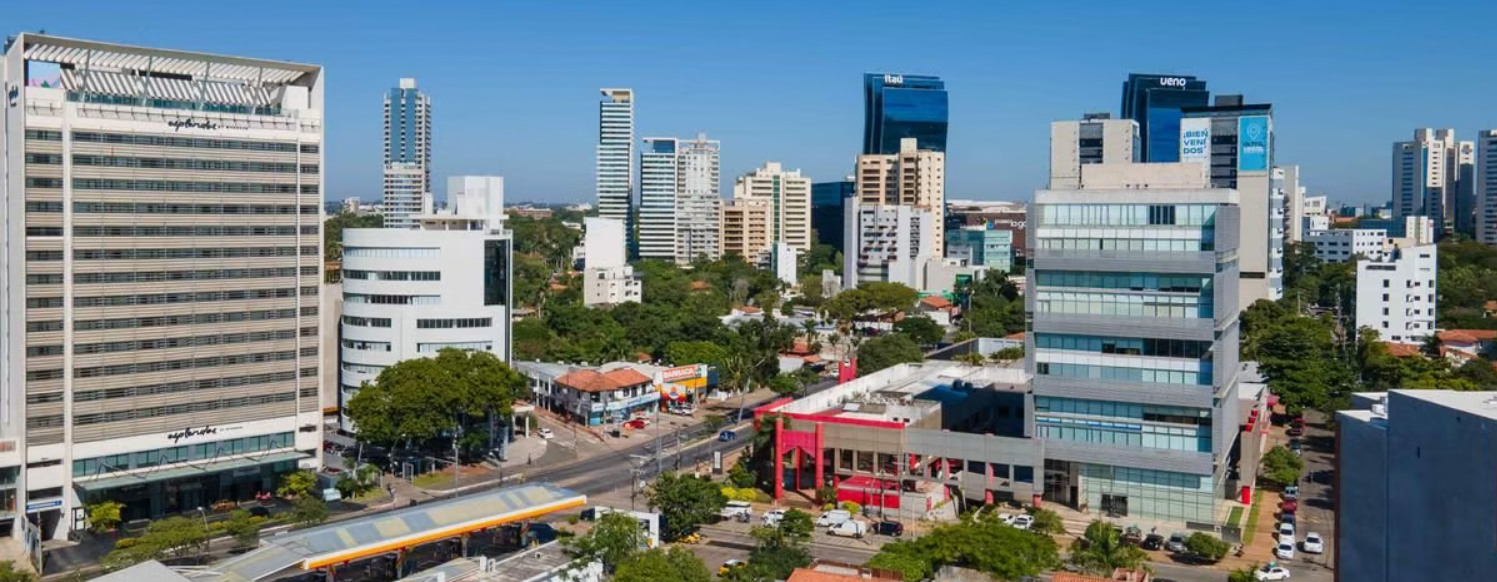
The damage need not take the form of a generalized bank run. It can arrive through several slower channels. Firms with frozen cash may defer wages, purchases or investment. Banks receiving new deposits may initially hold more liquidity instead of immediately expanding credit. Lenders may demand more documentation and charge more to compensate for uncertainty. Public institutions may need temporary financing even before their final losses are known.
These are transmission mechanisms, not measured national outcomes. They show why the government should distinguish the face value of frozen funds, the amount eventually recovered and the cost of the interruption. A business can recover its money in full and still suffer because it could not meet an obligation on time.
The fiscal accounting is equally important. Payment by a pre-funded deposit-guarantee mechanism is not automatically an equivalent new central-government budget expense. Losses at public entities, support to replenish resources, emergency financing or new political compensation commitments can create separate fiscal costs. These need to be recorded explicitly rather than folded into one dramatic number.
Paraguay should publish a consolidated exposure statement for affected public institutions. It should separate deposits from securities, identify maturities and immediate payment needs, and show recovery estimates as ranges until valuations become reliable. Listing every public exposure as a total loss would be premature. Treating every recorded balance as fully recoverable would be equally misleading.
The BCP’s response should have three practical priorities in the first phase. Complete accessible payments to eligible depositors; preserve and value the bank’s assets; and maintain essential payments through functioning institutions. None should wait for the conclusion of criminal proceedings, although investigators and resolution officials will need to coordinate preservation of evidence.
Preservation includes retaining the people and records needed to service sound loans. A bank in resolution still has borrowers, collateral, contracts and staff with operational knowledge. Destroying a viable collection process can reduce creditor recoveries. Resolution should impose losses and accountability where appropriate while preserving economic value that can still be recovered.
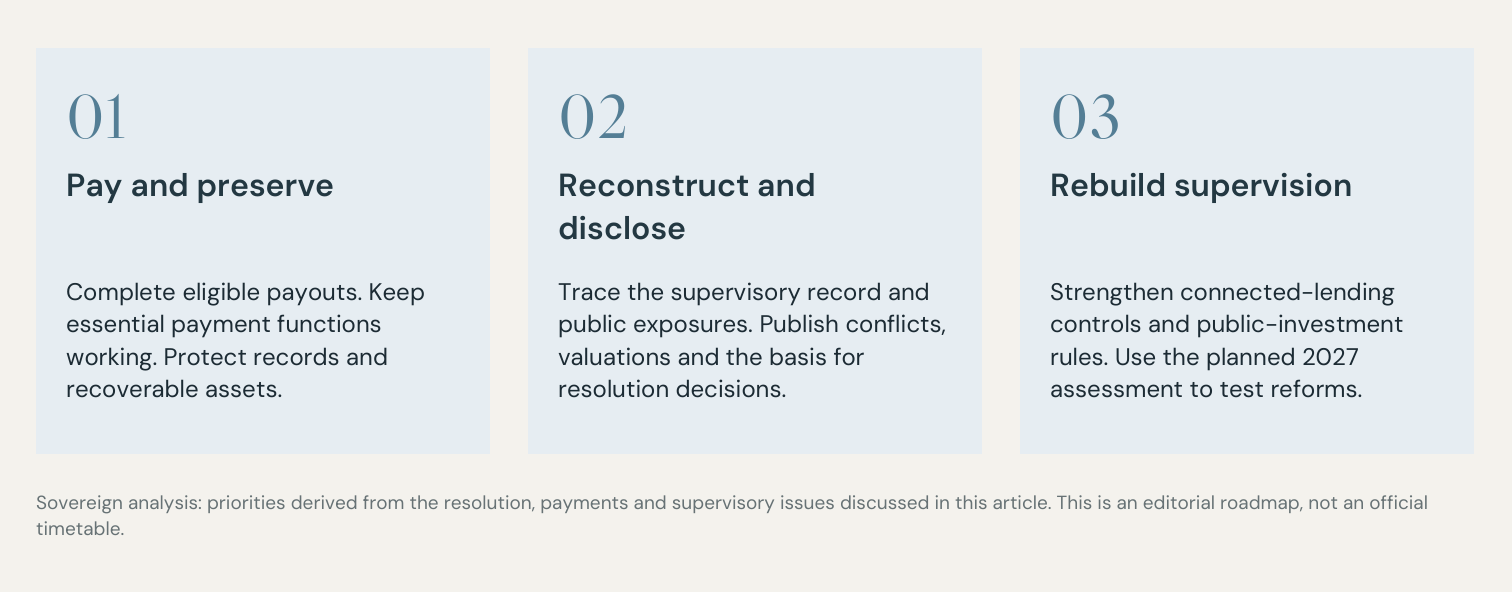
The choice among asset sales, transfers of suitable banking relationships and other legally available mechanisms should be made transparently. Our recommendation is to publish the rationale for the chosen route, the valuation approach and the safeguards against insiders acquiring assets on favorable terms. An urgent sale can restore services, but urgency also creates opportunities for value to move away from creditors.
The next phase requires an independent reconstruction of the supervisory record. It should establish when warning signs emerged, which accounting adjustments were required, what remediation deadlines were imposed and why the authorities considered each response sufficient at the time. Confidential borrower information can remain protected while decision timelines and institutional failures are explained.
A narrow inquiry confined to the last few days would be inadequate. The relevant period includes licensing, the merger, rapid expansion, public-sector placements and the response to later concerns. The objective should be to identify the point at which intervention could reasonably have reduced the loss or disruption, using the information then available.
Related-party oversight needs particular attention. Supervisors should assess control and economic dependence across a group, rather than rely only on company names or formal shareholding thresholds. Large exposures should be understood as a network of repayment risks. Boards must be able to demonstrate independent approval and genuine challenges to transactions involving connected interests.
Public investment governance should change alongside banking supervision. IPS and other state bodies need transparent counterparty limits, independent risk review and records explaining major placements. Concentration policy should consider shared ownership, correlated risks and the liquidity required to meet pensions or public-service obligations. A mandate to earn a return is not a mandate to maximize yield at the expense of access to funds.
Appointments at the BCP and other relevant institutions should be accompanied by published conflict-management arrangements. Former industry experience can be useful; it becomes a problem when there is no credible mechanism to handle prior relationships. Clear recusal procedures, documented decisions and effective oversight provide more protection than assurances about an appointee’s personal integrity.
The planned 2027 financial-sector assessment offers a framework for testing these changes. Paraguay should use it to obtain an external examination of consolidated supervision, resolution readiness, deposit-insurance operations and the links between banks and nonbank products. It should also publish a realistic implementation timetable. An international assessment is valuable when its findings change practice, not merely when its existence is cited as reassurance.
Three broad outcomes are possible. An orderly resolution with credible disclosure could contain the financial damage and strengthen supervision. A prolonged recovery process with incomplete accountability could leave banks functioning while confidence and investment remain weaker. Wider distrust could emerge if new evidence reveals comparable exposures elsewhere or if promised compensation undermines public finances. These are scenarios, not probability estimates.
The indicators are observable: payment completion, delays in contested claims, deposit movements across the system, unusual reliance on emergency liquidity, asset recoveries, pension-payment continuity and the financing of any compensation. Political announcements should be judged against those measures.
The comparison with Uruguay and Panama must survive scrutiny of their weaknesses. A useful banking center needs more than an attractive headline tax regime or convenient account opening. It needs institutions that can verify risk, enforce claims and maintain access to money when a prominent bank fails.
Uruguay’s principal banking supervisor is the Superintendencia de Servicios Financieros within the Banco Central del Uruguay. Its remit extends across regulated financial institutions and includes solvency, market conduct and financial integrity. Deposit protection is administered through COPAB and the banking deposit-guarantee fund.
The foreign-currency protection is modest: up to $10,000 per person per institution across covered foreign-currency deposits. Covered local-currency deposits have a separate limit of 250,000 inflation-indexed units, or UI. Principal and accrued interest fall within the applicable limits. A substantial dollar balance is therefore mostly outside the insurance ceiling, even in a jurisdiction we prefer.
The September 2026 IMF assessment nevertheless offers support for Uruguay’s banking fundamentals. It described banks as highly liquid and well capitalized, with capital ratios almost twice the regulatory minimum, and discussed further Basel III and crisis-management reforms. It also identified dollarization risks and recommended stronger legal central-bank independence, including appointment terms less closely tied to electoral cycles.
That is a more credible basis for an editorial preference than claiming Uruguay has solved institutional risk. A good system still needs reform. It also has a history from which to learn: in 2002, bank failures and deposit flight required emergency measures, and dollar time deposits at the state banks were rescheduled. Uruguay’s current standing cannot responsibly be presented as an unbroken history of immediate depositor access.
Our view is that Uruguay deserves consideration for its present supervisory structure, demonstrated buffers and attention to crisis-management capacity. The judgment concerns current arrangements and their implementation. It does not turn an Uruguayan address into a guarantee or remove the need to examine the chosen bank.
Panama offers a different model. Its Superintendencia de Bancos was created by Decree-Law 9 of 26 February 1998, replacing an earlier regulatory arrangement with stronger powers and administrative and financial autonomy. Subsequent reforms expanded the scope of supervision over banking groups, including holding companies. These are relevant capabilities when risks can move among affiliated entities.
The country’s longstanding international banking center and dollar-based financial system are part of its appeal for regional business and treasury activity. They also create a particular constraint: Panama has no central bank able to create dollar liquidity. A bank must obtain dollars from its own liquid assets, markets, shareholders or other available funding. Dollar denomination removes one currency conversion problem; it does not remove bank credit risk.
Panama also lacks a general deposit-insurance system, as the country’s Financial Coordination Council explains in its description of the banking model. The IMF’s detailed safety-net assessment identified that gap, distinguished explicit guarantees at state-owned banks and called for stronger resolution arrangements. Its October 2026 mission continued to emphasize the need to strengthen financial safety nets and proposed a carefully designed public-sector liquidity facility.
The same mission described the banking system as well capitalized and profitable, but highlighted risks in construction, commercial property, housing and consumer lending, and the need for heightened attention at some banks. Those qualifications belong in any serious recommendation of Panama.
There are concrete reminders that its supervision cannot prevent every failure. The Panamanian regulator ordered AllBank into compulsory liquidation in November 2019, citing financial, operational and governance conditions that made reorganization or sale inappropriate. The relevant claim for Panama is that its framework and banking ecosystem merit consideration, not that deposits there cannot become trapped.
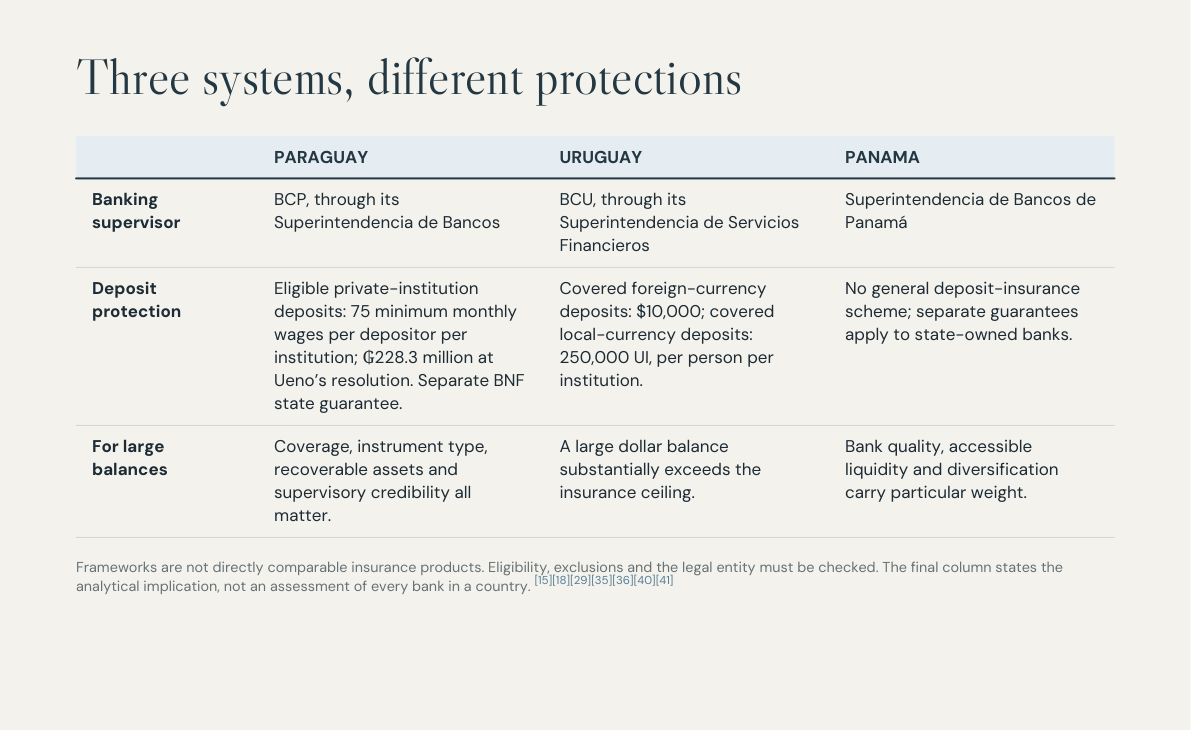
Our preference for Uruguay and Panama is therefore best expressed as a starting point for bank selection. It is not a recommendation to concentrate every asset in either jurisdiction. A foreign parent, a familiar brand or a local state guarantee can improve one aspect of the analysis while leaving others unresolved. The depositor’s actual contractual counterparty remains central.
For an internationally mobile household or business, the practical distinction is between money needed for local transactions and money intended as a durable reserve. Living in Paraguay may create legitimate reasons to maintain Paraguayan banking relationships. It does not follow that all liquid capital should share the same institution, legal system and payment infrastructure.
Separate institutions are useful only if the separation is real. Two accounts under different brands may depend on the same banking group. A dollar account can remain exposed to the same local resolution law as a guaraní account. A securities portfolio held in custody has different ownership and insolvency questions from a cash deposit, and still requires examination of custody and counterparty arrangements.
A sensible structure begins with those distinctions and with a second functioning route for essential payments. It also recognizes that high interest, cashback and convenient technology compensate or reward customers for something; they do not provide independent evidence of safety. A reserve has a different purpose from a promotional banking product.
Paraguay can recover from this episode. Its productive economy does not disappear because a bank fails, and the existence of a resolution framework and functioning successor government provides a basis for action. But recovery will require more than describing Ueno as an isolated case. That conclusion must be supported by verified exposures, credible supervision and the treatment of people whose money became inaccessible.
The new government has an opportunity to make the state less dependent on personal assurances and more dependent on rules that can be examined. It can demonstrate that public money is placed on defensible terms, that connected lending is identified early, and that resolution protects ordinary economic activity while losses and responsibility are allocated transparently.
For Sovereign’s readers, the lesson is practical: choose a residence, an investment and a banking jurisdiction on the evidence relevant to each decision. For Paraguay, the test is whether the institutions now responding to failure can be made strong enough to intervene before the next one becomes a national emergency.
Research current through 8 November 2026. Historical balances are reported figures, not recovery valuations. Documentary archive photographs; cropped for layout. Sources and photograph credits below.
Sources & photograph credits
- BCP: initiation of Ueno’s resolution2026-11-03
- Paraguayan Senate: removal of Santiago Peña and account of the defense2026-11-06
- Paraguayan Foreign Ministry: presidential succession and constitutional term2026-11-07
- ABC Color: Moody’s assessment of Ueno’s resolution, market shares and insured deposits2026-11-05
- Ueno: 2025 financial statements, especially notes on incorporation, license and Visión merger2025-12-31
- Ueno: 2021 annual report2021-12-31
- Paraguayan Football Association: Ueno sponsorship and public-launch history
- Última Hora: service integration following the Visión merger2024-07-02
- Ueno: open letter on capital, deposits and funding
- 5Días: OTP statement on its minority investment and absence of control rights2026-11-03
- Ueno: first-quarter earnings presentation2026-05-08
- La Nación: deposits ranking based on September BCP data2026-11-07
- Itaú Paraguay: institutional history and group affiliation
- FIX: completion of Sudameris’s absorption of Banco Regional2023-07-03
- Paraguay Law 5800: BNF charter, especially Articles 1 and 6
- La República: Paraguay’s banking participants and discussion of fiscal exposure2026-11-07
- Paraguay Law 2157: INCOOP’s legal mandate
- Paraguay Law 2334: deposit guarantee and financial-institution resolution
- BCP: banking and financial-sector legislation
- BCP: financial indicators, September 20262026-09-30
- IMF: Paraguay 2026 Article IV report
- Ueno: proposed $100 million capital plan2026-10-29
- Paraguayan Public Prosecutor: charges against 27 people and alleged financial transactions2026-11-04
- EFE: IPS exposure, pension payments and political connections2026-11-04
- Paraguayan Public Prosecutor: detention orders for Peña and Carvallo2026-11-06
- ABC Color: preventive-detention decision concerning Peña2026-11-07
- Associated Press: charges against the ousted president and his denial
- Reuters: Pedro Alliana’s political background2026-11-07
- BCP: official deposit-guarantee payments information
- Sudameris: explanation of covered and excluded deposit products
- Paraguayan Senate: accelerated guarantee advances2026-11-04
- BCP: first group of deposit-guarantee payments2026-11-05
- Diario HOY: BCP briefing on 1.196 million payment beneficiaries2026-11-07
- BCP securities supervisor: temporary redemption restrictions and valuation rules2026-11-03
- BCU: mandate of the Superintendencia de Servicios Financieros
- COPAB: deposit-insurance coverage
- IMF: Uruguay 2026 Article IV mission statement2026-09-24
- Uruguay sovereign disclosure: account of the 2002 banking crisis
- Panama SBP: history of the regulator and banking-law reforms
- IMF: Panama FSAP technical note on safety nets, resolution and crisis management2024-07-19
- IMF: Panama 2026 Article IV mission statement2026-10-07
- Panama SBP: compulsory liquidation of AllBank2019-11-08
- Panama Financial Coordination Council: description of the financial system
- ABC Color: Ueno defendants and Vázquez’s executive role2026-11-05
- BCP: Carlos Carvallo Spalding takes office; Decree 214 and Senate consent2023-09-07
- BCP Organic Law 489/95, article 9: board composition and appointment
- Law 6104/18: amendments to BCP governance and banking supervision2018-07-03
- Law 7572/25: securities and products market, BCP and Superintendencia de Valores2025-11-07
- Photo: Isaac Castillo / Presidencia de la República del Ecuador — pena
- Photo: Ueno Bank — ueno front