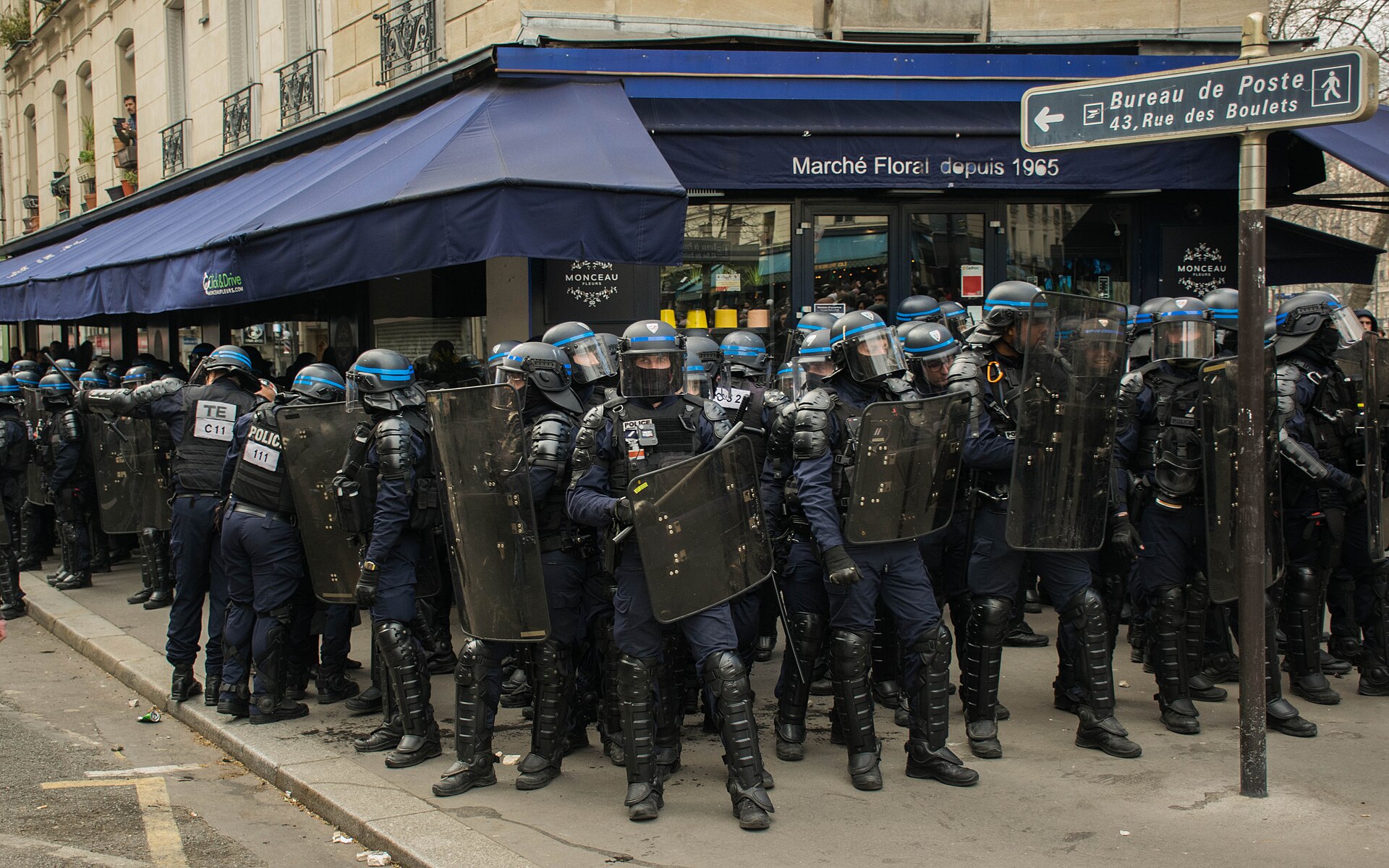
Why Germany’s unrest matters for Europe
A guide for readers outside Germany to the pressures behind the protests—and how weak growth, expensive housing, an ageing welfare state and the return of military obligation can unsettle Europe’s political balance.
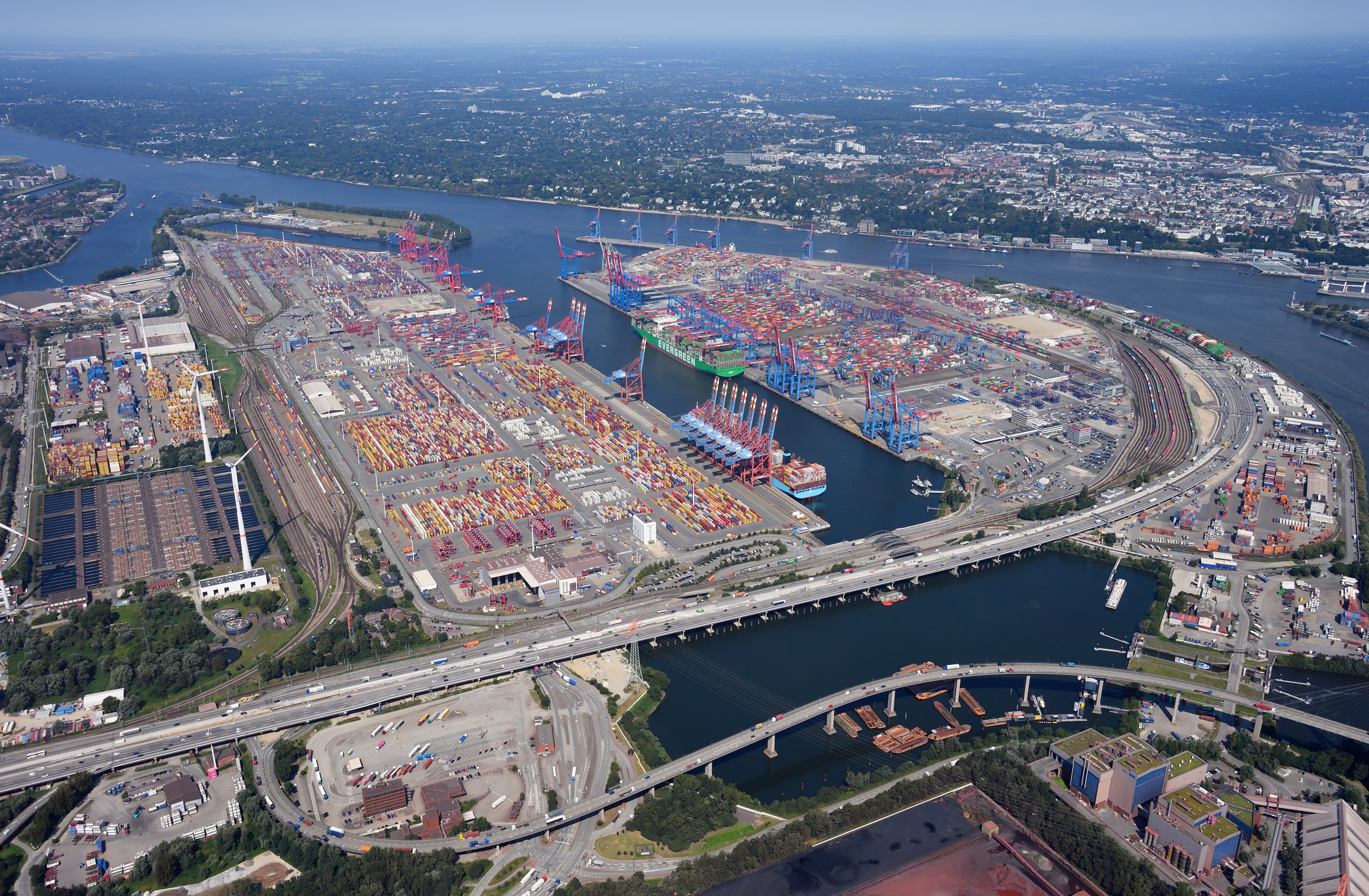
The photographs are dated documentary archive images chosen to explain the issues. None depicts the demonstrations of 31 October 2026. All are shown in full frame; publication copies are resized without cropping.
A trade gateway, not just a German city — Hamburg, 13 August 2024 (archive). The Eurogate and Burchardkai container terminals, seen from the southeast. The port provides a visual starting point for understanding Germany’s connections to global trade. Photo: Carsten Steger; CC BY-SA 4.0; original image.
A German protest, a European question
For someone watching from outside Germany, images of young protesters and broken shop windows invite an unsettling question: if one of Europe’s richest and most influential countries is struggling to keep its young people confident in the future, how secure is the continent’s wider political settlement?
The demonstrations of 31 October expose a collision between expensive everyday life, an industrial economy under strain and a state asking younger citizens to shoulder more responsibility for national defence. Organisers put participation across Germany at about 100,000, according to the Financial Times; that is an organisers’ estimate, not an independently verified national count. German reporting described largely peaceful demonstrations alongside serious disorder in several cities. Neither the organisers nor those who committed violence speak for an entire generation. [1–5]
Germany matters because its domestic difficulties have unusually large consequences beyond its borders. It produced 23.8% of the European Union’s economic output in 2025. Its factories sit inside production networks that extend across neighbouring countries. Its government influences European financial and security decisions. When German companies hesitate to invest, households restrain spending or political leaders struggle to build agreement, the effects can travel. [38,42,43]
The word “instability” needs precision. Here it means a combination of economic insecurity, conflict over public resources, fragmented political support and increased exposure to security shocks. A demonstration is not evidence of state failure. Germany still has functioning institutions, considerable wealth and comparatively low youth unemployment. The danger is that these strengths become harder to translate into opportunity, effective government and public consent.
That is the broader European story. For decades, prosperity, welfare provision and relative security helped democratic governments manage competing demands. Today, growth is weaker, populations are ageing, industrial competition is sharper and Russia’s war has changed the security environment. The question is whether governments can renew that bargain before disappointment becomes a durable political identity. Germany is a particularly consequential test of the answer. [40,44,45]
Where Germany fits
Germany links western markets with central European production centres and sits behind NATO’s eastern flank. Hamburg’s port, Frankfurt’s financial services and Berlin’s institutions play distinct roles: Germany is not a single industrial town, political mood or housing market.
International coverage often blurs three institutions. The European Union is a political and economic union; the euro area is the group of EU countries using the euro; NATO is a separate military alliance. German economic weakness affects trade and the monetary outlook. A security crisis engages different commitments. Those relationships overlap, but they are not interchangeable.
German frustration does not automatically become EU policy. Governments must negotiate across different interests. Common foreign and security policy decisions generally require unanimity, with defined exceptions. Domestic political weakness can complicate collective action without making it impossible. [43]
- EU: The political and economic union. Germany’s economy is its largest.
- Euro area: EU countries sharing the euro and a common monetary policy. It does not include every EU member.
- NATO: The military alliance linking European and North American allies. Its membership differs from the EU’s.
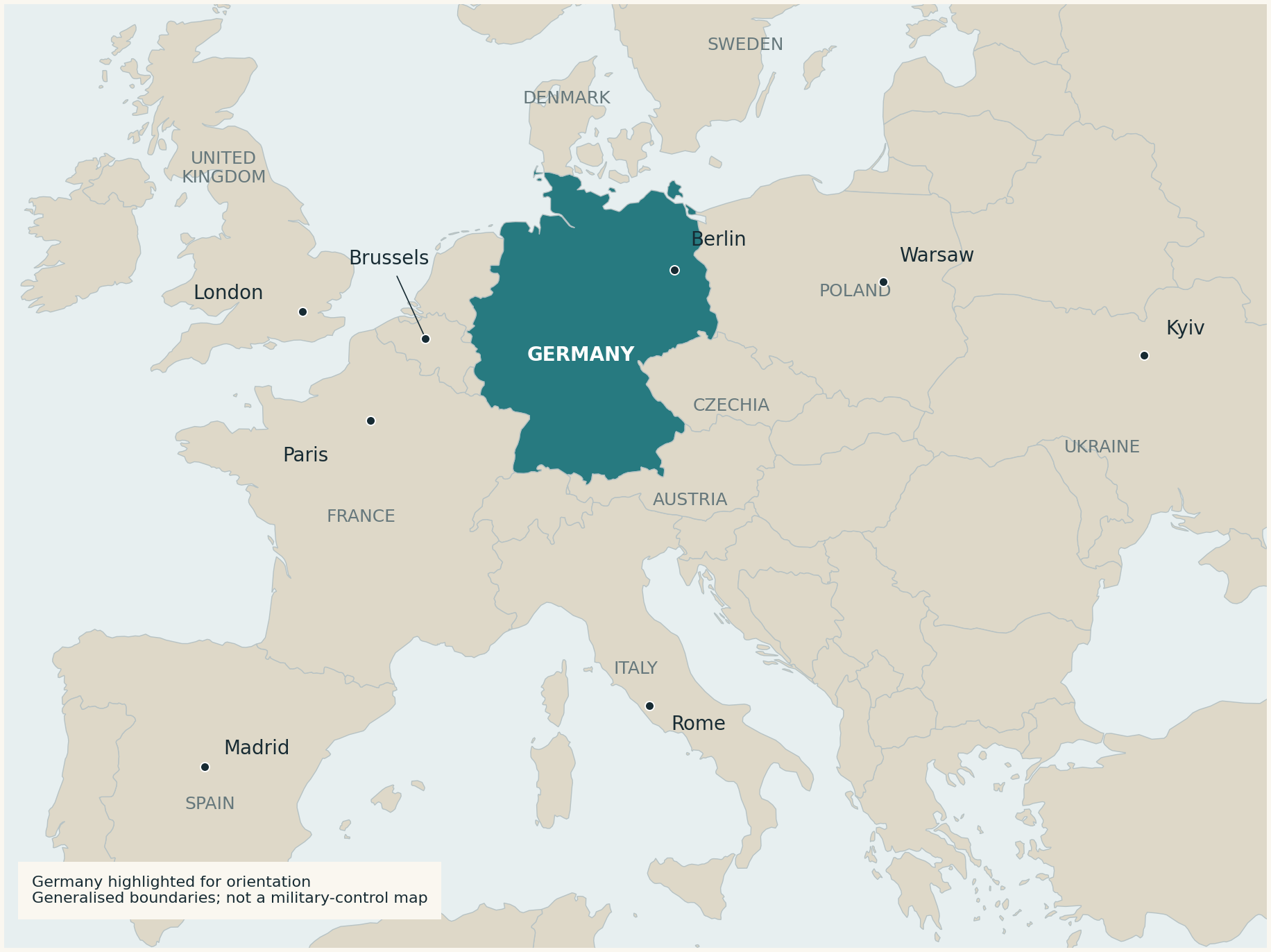
Germany in its European neighbourhood. Selected capitals for orientation. Germany connects major western markets with central European production networks. Generalised boundaries; not a military-control map. Geographic data: Natural Earth [37].
What happened—and what the images cannot tell you
The protest geography was broad, but the events were not uniform. In Frankfurt am Main, hessenschau reported about 8,000 participants by the police estimate and 10,000 according to organisers. Police dissolved the demonstration after repeated incidents involving fireworks and projectiles. Later came smashed windows and looting in the central shopping district. Local reporting said many involved in that later disorder had not joined the march. [3]
Hamburg and Cologne saw confrontations and water-cannon deployments. AFP reported incidents in Leipzig and a more limited confrontation in Bonn. In Berlin, the rally at the Brandenburg Gate and the later march beginning at Rosenthaler Platz were separate events; AFP said the evening protest was not organised by GenZ regelt, one of the groups behind the daytime mobilisation. A local Munich report described a largely festive demonstration. [4–7]
Representation also deserves scrutiny. Ahead of the protests, rbb reported that the Bundesschülerkonferenz, the national school-student representative body, had distanced itself from GenZ regelt over insufficient transparency about its leadership. The concerns of students and apprentices cannot be reduced to the claims of one organising group. Online registrations, organisers’ estimates and police attendance figures also measure different things. [8]
For an overseas audience, the lesson is to resist treating the most dramatic footage as a national diagnosis. Peaceful assembly, disruptive protest and criminal violence are different categories. A state must protect the first, manage the second within the law and investigate the third. The fact that several occurred on the same weekend does not make Germany a country in general revolt.
The underlying demands nevertheless deserve attention. Education, housing, employment and military service all shape the transition into adult life. For a young person, they are connected: can I afford to move, find work, complete my training and decide what happens next? The political force of the protests comes from that accumulation of pressures, not from any single economic statistic.
The German cities in the reporting
This is a selective map of locations identified in reporting on 31 October, alongside major cities for orientation. The red markers identify places where disorder was reported; they do not imply equal severity, a common organiser or continuous unrest. Gold markers identify reported demonstrations without a claim here of violent disorder. Grey markers provide geographic context and do not establish that no protest occurred. [3–8,36]
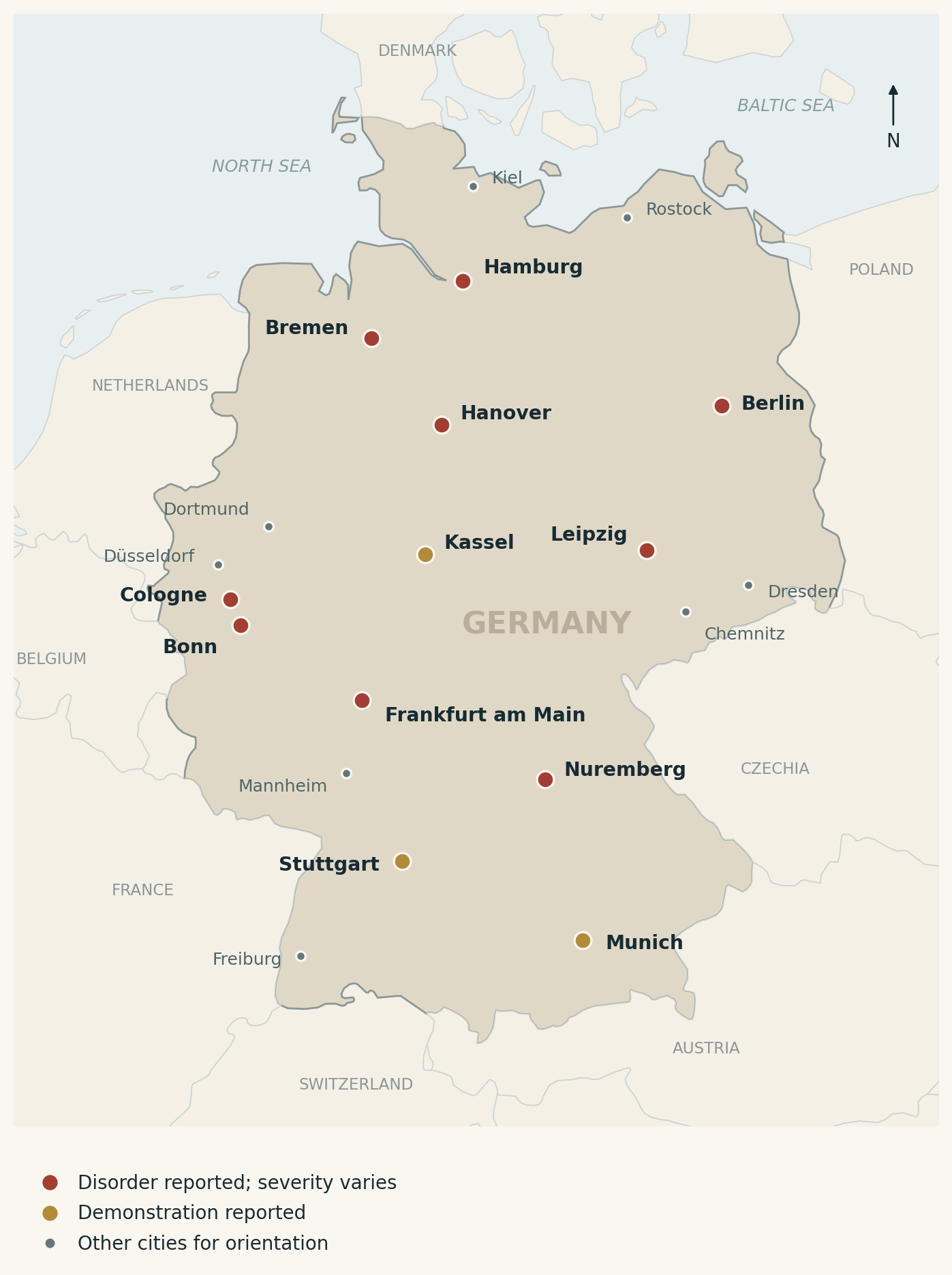
Germany, city by city. Selected reported protest locations on 31 October 2026, alongside major cities for orientation. Marker size does not represent turnout or severity; grey markers do not establish an absence of protests. Sources [3–8,36]; geographic data [37].
Why a German slowdown crosses borders
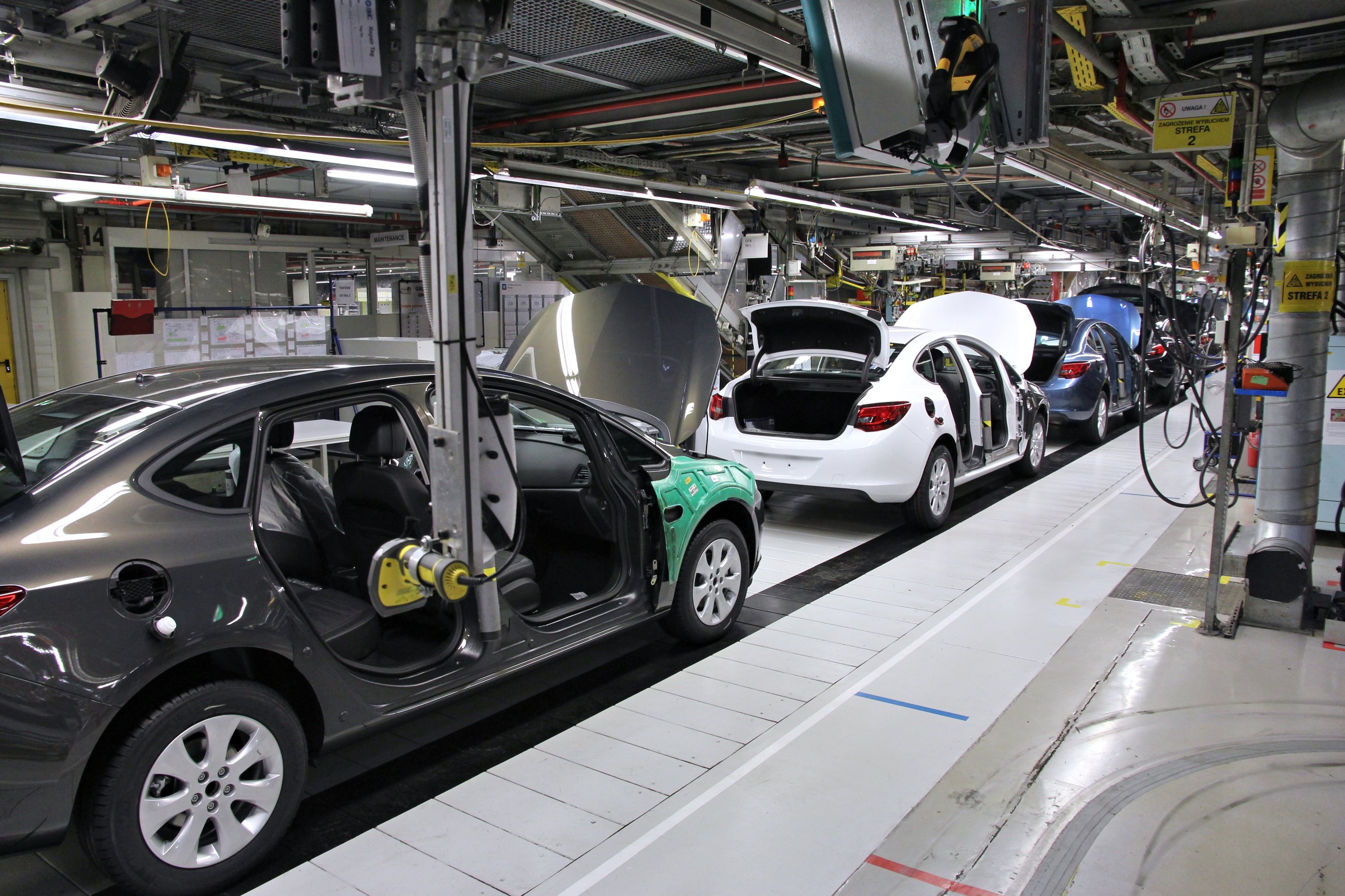
Production networks cross national borders — Gliwice, Poland, 19 September 2015 (archive). An Opel assembly line at the then General Motors Manufacturing Poland plant. This archive photograph illustrates why European car production cannot be understood within national borders alone. Photo: Marek Ślusarczyk / Tupungato; CC BY 3.0; original image.
Germany’s economic model is built around more than famous car brands. It includes machinery, chemicals, engineering and specialised suppliers, many of them part of the Mittelstand: the broad population of small and medium-sized businesses often associated with family ownership and specialist expertise. These firms sell abroad and buy components, services and labour across borders. The European Central Bank has described Germany as a central manufacturing hub in European value chains. [40,42]
That creates a simple transmission mechanism. If a German manufacturer postpones a production line, a supplier elsewhere may lose an order. If a German household delays buying a car or taking a holiday, demand can weaken beyond Germany. These are economic channels, not proof that every German setback produces an equal decline in each neighbouring country. Exposure varies by sector, trade relationship and the strength of local demand.
China illustrates the change in the competitive environment. A large market for European manufacturers has also become a source of increasingly capable competitors. ECB analysis published in 2026 describes uneven exposure across the euro area, with Germany particularly affected through manufacturing, machinery and transport equipment. Competition reaches firms through sales in China, imports into Europe and rivalry in third-country markets. [41]
Energy costs, ageing, weak investment and administrative obstacles add to the pressure. The European Commission’s 2026 country report describes an economy with almost no real growth since 2019 and private investment below its 2015 level by 2025. The issue is not simply a bad quarter. It is whether Germany is building enough productive capacity to sustain its wage levels and public commitments. [40]
For younger workers, industrial restructuring can arrive as fewer entry-level openings before it appears as mass unemployment. Employers can shrink through retirement, attrition and reduced recruitment. That protects some existing employees while narrowing the door for people trying to enter. A country can preserve many established jobs and still weaken the promise made to the next cohort.
Recession is the wrong shorthand for the latest data
Germany’s recent history of stagnation is real. Calling the economy currently trapped in recession would go beyond the latest evidence. Destatis’s preliminary estimate showed real GDP increasing 0.2% in the third quarter of 2026 from the previous quarter. The distinction matters: an economy can return to growth while households and industries remain under sustained pressure. [15]
Nor is Europe moving as one. Eurostat’s initial third-quarter estimates showed EU output rising 0.5%, with Spain up 0.6%, Germany up 0.2%, Italy unchanged and France down 0.1%. These are quarterly changes, adjusted for seasonality and calendar effects, and subject to revision. A continent-wide description of recession would obscure those differences. [39]
There is evidence of resilience. Bloomberg’s report on Germany’s October business survey noted that expectations improved for a sixth consecutive month, even while companies’ assessment of current conditions remained weaker. Expectations are not completed investments or jobs, but they caution against assuming an uninterrupted downward trajectory. [18]
For international readers, the useful distinction is between the economic cycle and the economy’s underlying capacity. A cyclical recovery raises output after a weak period. A stronger productive base requires investment, skills, infrastructure, innovation and firms able to compete. The former can begin before the latter has been secured. That gap helps explain why official growth and popular frustration can coexist.
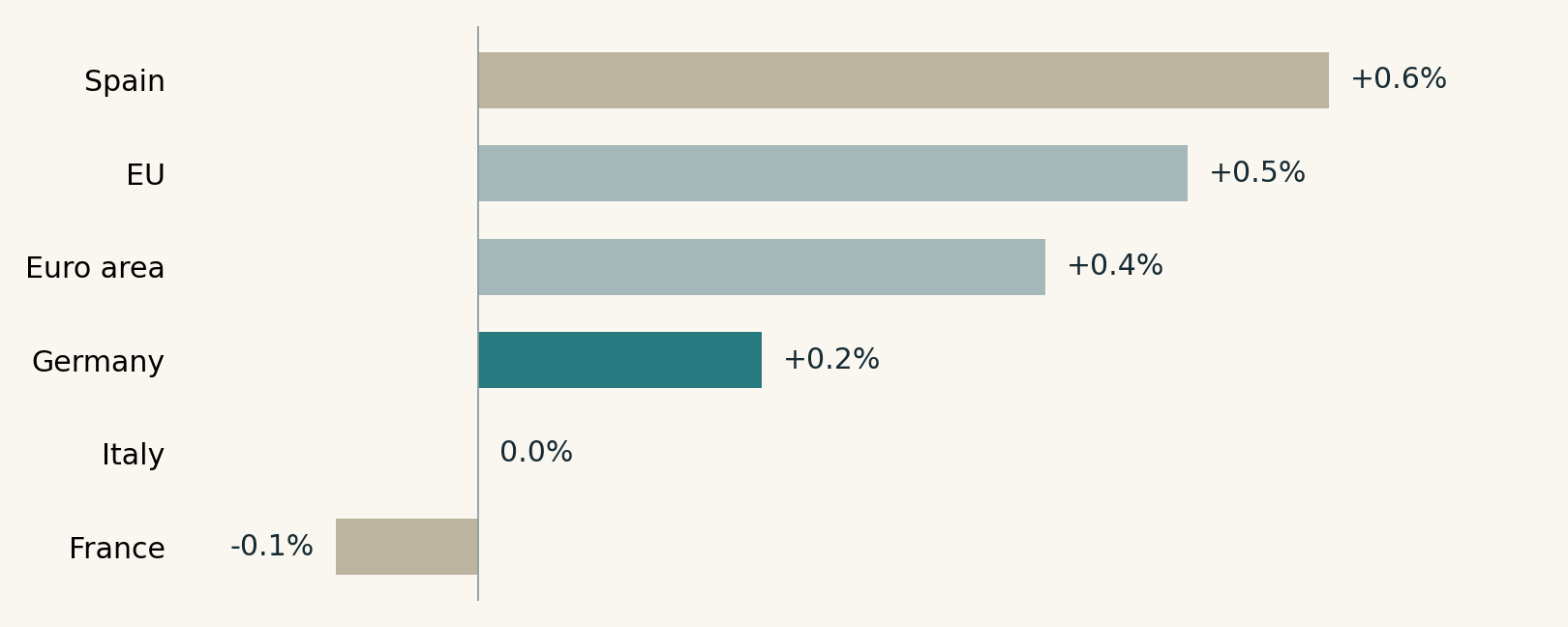
One continent, different economic directions. Real GDP change from the previous quarter, Q3 2026: Spain +0.6%, EU +0.5%, euro area +0.4%, Germany +0.2%, Italy 0.0%, France −0.1%. Seasonally and calendar adjusted; preliminary estimates subject to revision. Source: Eurostat [39].
A job is not the same as a secure start
Germany’s youth unemployment rate remains relatively low. In September 2026 it was 7.5%, compared with 15.5% across the EU, 21.9% in France and 22.8% in Spain. These figures describe unemployed people as a share of economically active under-25s, not the share of all young people without work. Students outside the labour force are excluded; Eurostat uses a smoothed trend measure for Germany. [9]
Part of Germany’s distinctive route into work is its dual training system: apprentices combine paid workplace training with vocational education. For readers used to a sharper divide between university and employment, this helps explain why school-to-work transitions matter so much in German policy. An apprenticeship is both an educational opportunity and the beginning of an occupation.
The latest registered apprenticeship market shows strain. Employers registered 453,000 company-based places in the 2025/26 reporting year, 31,000 fewer than a year earlier. At the end of September, 46,000 registered applicants had neither a placement nor an alternative, while 48,000 places remained vacant. These are employment-agency registrations, not a census of all school-leavers and vacancies. [11]
Vacancies and disappointed applicants can coexist because the available occupation, location or entry requirements do not match the person seeking a place. Moving may require rent and a deposit that a training wage cannot support. A labour shortage in one trade does not mean a young applicant in another region can readily obtain a suitable job.
The international comparison therefore cuts both ways. Germany has avoided the scale of youth joblessness seen in some European peers. Yet a low unemployment rate does not measure whether a job pays enough for independence, whether recruitment leads to progression or whether a family must subsidise the first years of working life. Those are central to the political experience of the labour market.
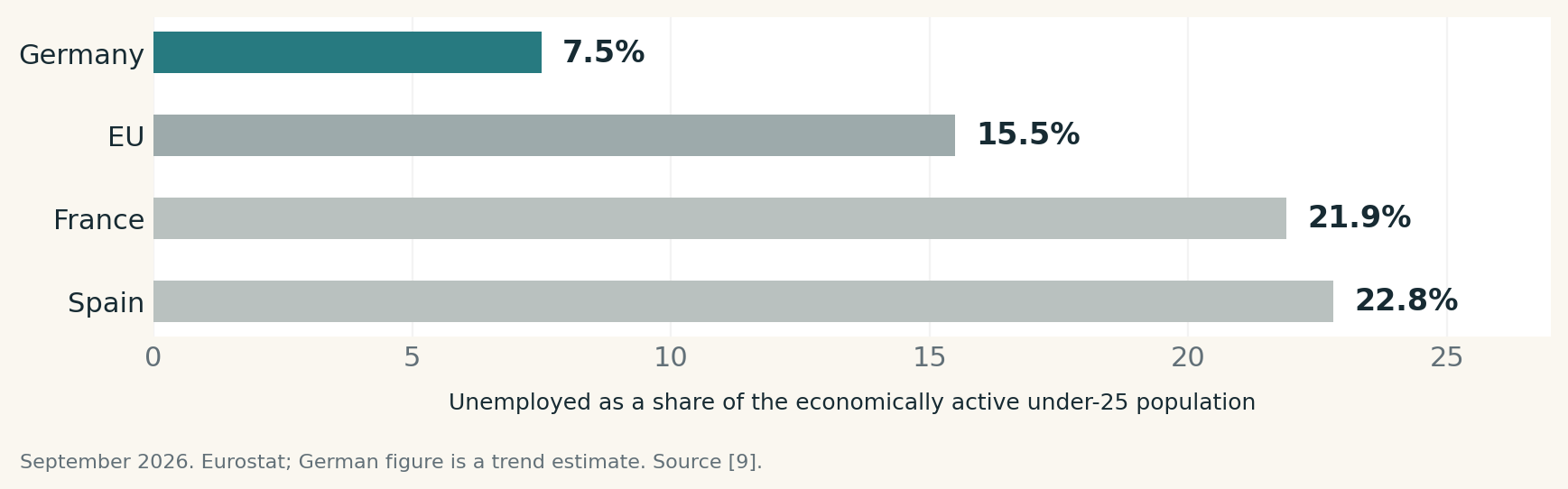
Youth unemployment: a comparatively strong German position. September 2026: unemployed under-25s as a share of the youth labour force. Germany 7.5%, EU 15.5%, France 21.9%, Spain 22.8%. Students outside the labour force are excluded; Germany uses a smoothed trend measure. Source: Eurostat [9].
Housing is where the national problem becomes personal
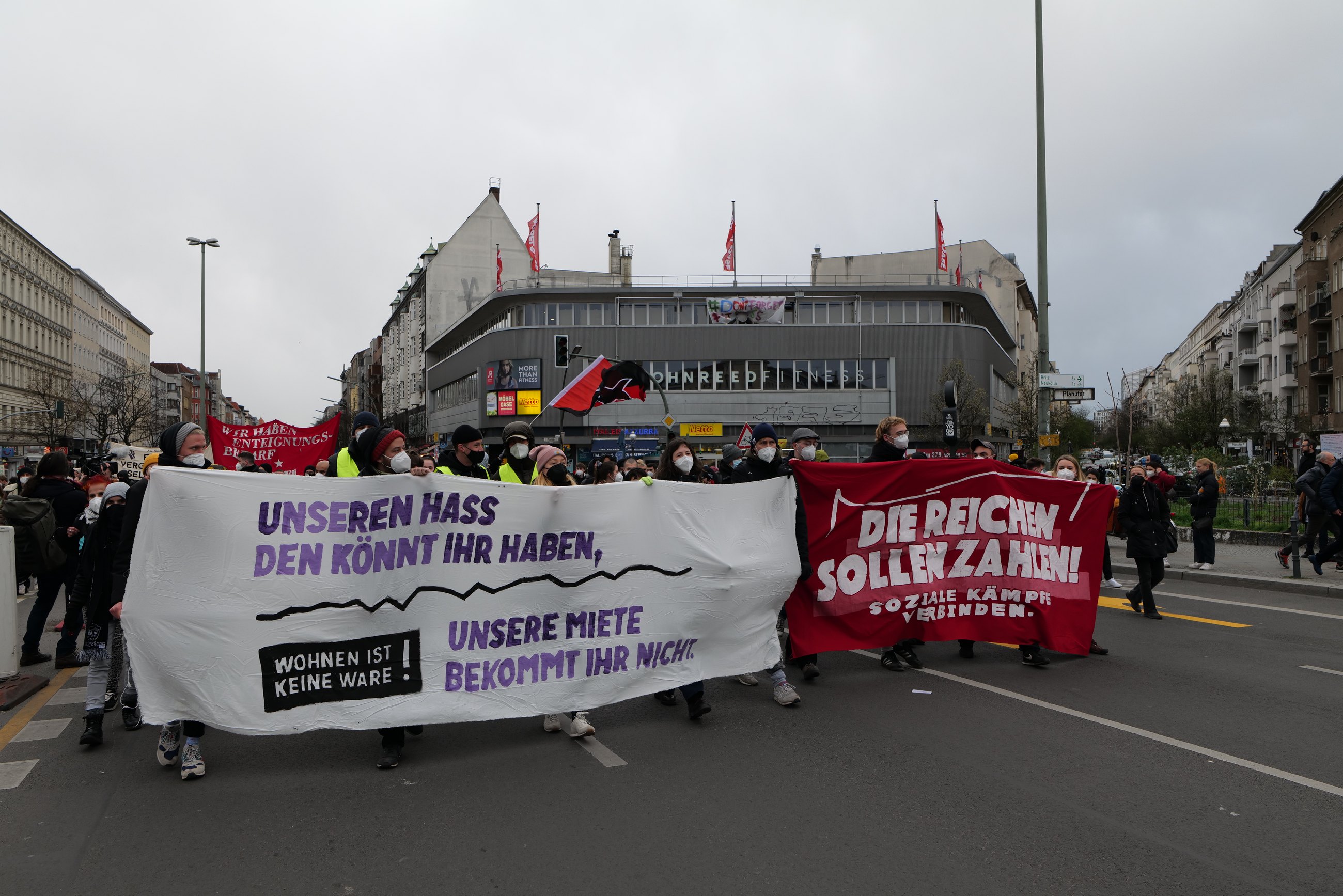
The long politics of the rent bill — Berlin, 15 April 2021 (archive). A demonstration after the court decision overturning Berlin’s rent cap. Housing grievances predate the October 2026 protests; this is a separate event. Photo: Leonhard Lenz; CC0 1.0; original image.
The 2026 MLP student-housing report, produced by the Institut der deutschen Wirtschaft, estimated the monthly cost of its model student apartment at about €880 including heating in Munich and €280 in Chemnitz. Germany’s BAföG student-support system included a €380 housing allowance; that covered the model rent in only Chemnitz among the 38 locations examined. These are modelled student-apartment costs, not average rents for every dwelling. [12]
The comparison explains a practical inequality. A young person with access to family money, an existing tenancy or a spare room can accept an opportunity that another person with identical qualifications cannot. High-productivity cities can offer better jobs while making entry prohibitively expensive. Geography and family wealth shape the freedom to move.
Slower inflation does not undo this. Destatis’s initial estimate put October annual inflation at 2.8%, down from 3.3% in September. That means prices were rising more slowly overall, not that the price level had returned to where it was before the shocks. A new rental contract can still be substantially more expensive than the contract a parent or older colleague signed years earlier. [13]
Public services compound the pressure. KfW’s 2026 municipal panel estimated a perceived investment backlog of €231.2 billion, including €68.9 billion for schools. This is an extrapolation from local finance officials’ assessments, not an audited bill. It nevertheless helps explain why a wealthy country can feel less capable in everyday life than its national income suggests. [14]
Housing, education and transport reinforce one another. A cheaper home is less useful if the journey to training is unreliable or expensive. A national investment announcement has little immediate meaning to a family whose school still needs repairs. The political question is whether the state’s capacity is visible where people live, rather than only in large budget numbers.
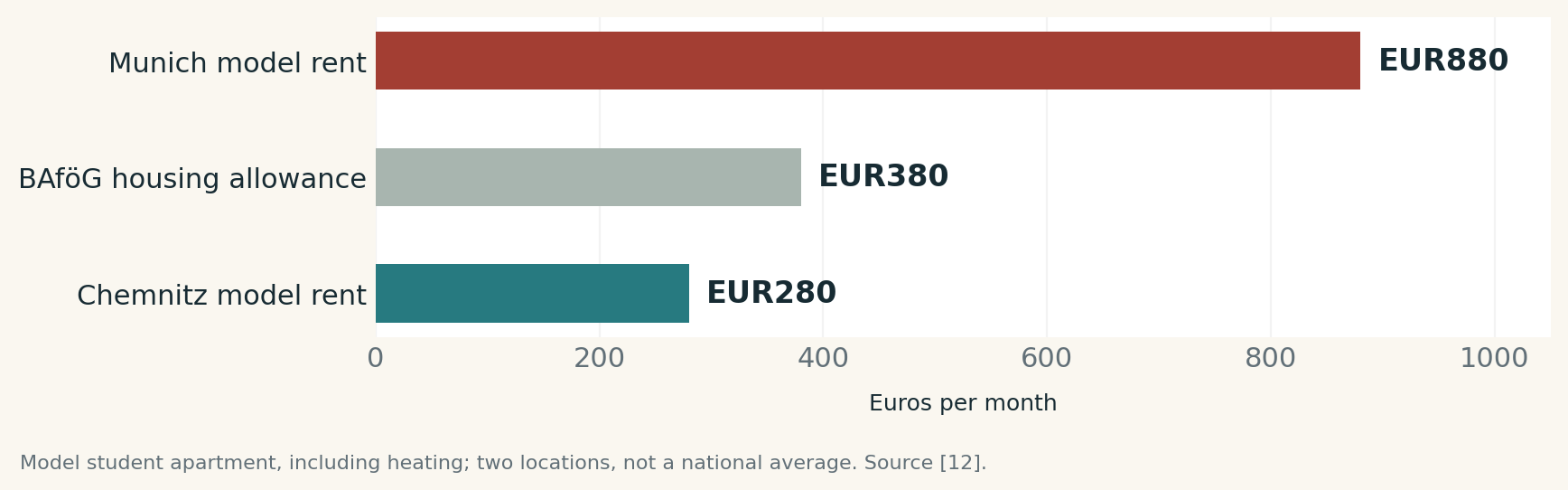
The cost of independence varies sharply by city. Model monthly student-apartment costs including heating: Munich €880 and Chemnitz €280, compared with the €380 BAföG housing allowance. These are not average rents for all homes. Source: MLP / IW student-housing report 2026 [12].
The energy shock changed the bargain
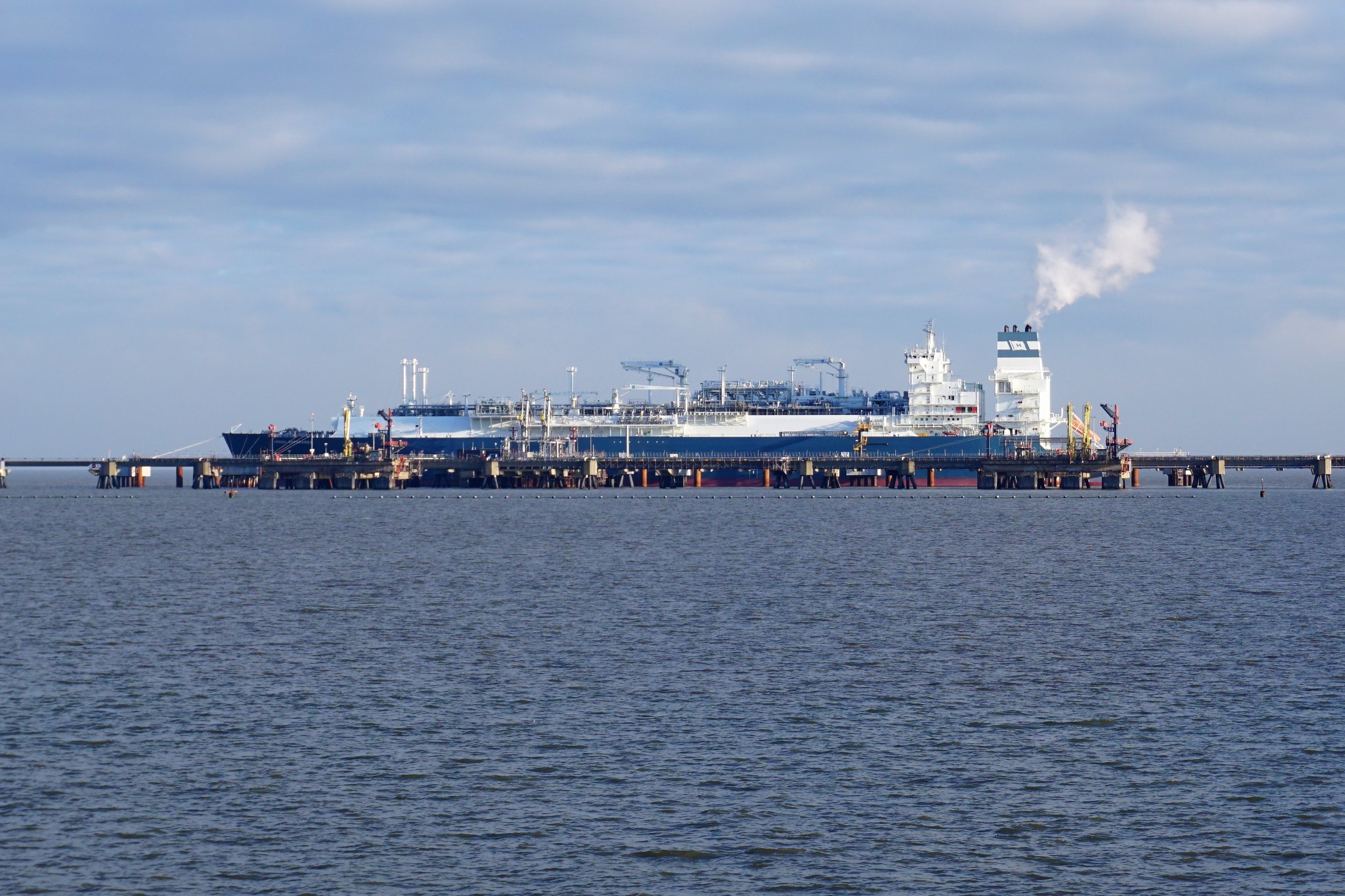
A new route for imported energy — Wilhelmshaven, 21 January 2023 (archive). The Höegh Esperanza, a floating LNG storage and regasification vessel. Infrastructure like this helped Germany diversify gas supplies after the rupture with Russia. Photo: Ein Dahmer; CC BY-SA 4.0; original image.
Germany’s energy story is often simplified into an argument about a single technology. The wider issue is the loss of an old cost and security assumption. The government’s historical account put Russia’s share of German gas supply at roughly 55% at the start of 2022. The full-scale invasion of Ukraine exposed the danger of relying heavily on a supplier that had become a strategic adversary. [49]
Germany diversified through pipeline imports and liquefied natural gas, or LNG: gas chilled for shipment by sea and converted back into gas at receiving facilities. The government now describes a more flexible supply system, supported by imports, lower demand and connections with neighbouring countries. Diversification improved resilience. It did not promise a return to the earlier price environment. [48]
Household gas prices in the first half of 2026 were 80.7% above their level in the first half of 2021; electricity prices were 16.4% higher. These are five-year comparisons of household prices, not annual inflation rates or the prices paid by every industrial user. They explain why households can hear that the emergency has eased while still feeling substantially worse off. [22]
For industry, competitiveness depends on the full delivered cost and reliability of energy: wholesale prices, networks, taxes and charges, contracts and the technology a plant uses. Subsidies can provide relief, but lasting improvements also require investment in generation, grids, connections and efficiency. Household and industrial price series should not be treated as interchangeable evidence.
The European connection is immediate. Interconnected electricity and gas systems can share supply and cushion shocks, while disruptions can also transmit costs. Industrial policy introduces another tension: if richer governments can subsidise domestic firms more heavily, partners may worry about unequal competition. That is an analytical risk to the single market, not proof that every national energy measure is unfair. Germany’s response has to strengthen its productive base while remaining compatible with the European market on which that base depends.
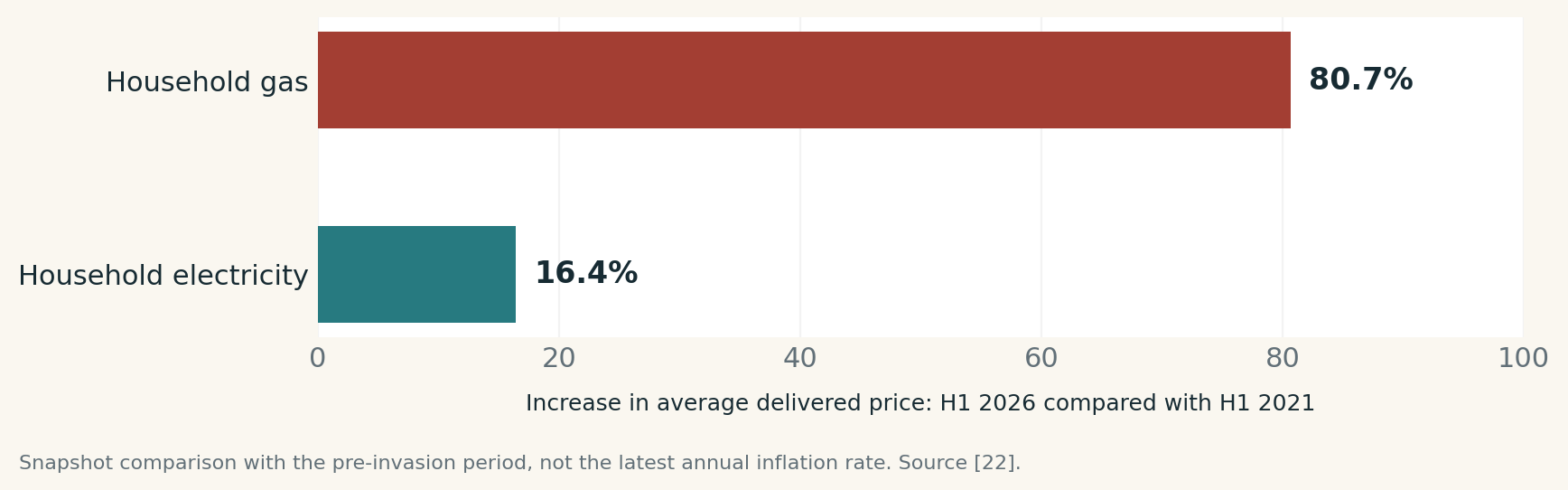
The emergency eased; the earlier price level did not return. Household gas prices +80.7% and electricity prices +16.4%, first half of 2026 compared with first half of 2021. These are five-year changes, not annual inflation or industrial prices. Source: Destatis [22].
An ageing welfare state meets a fragmented electorate
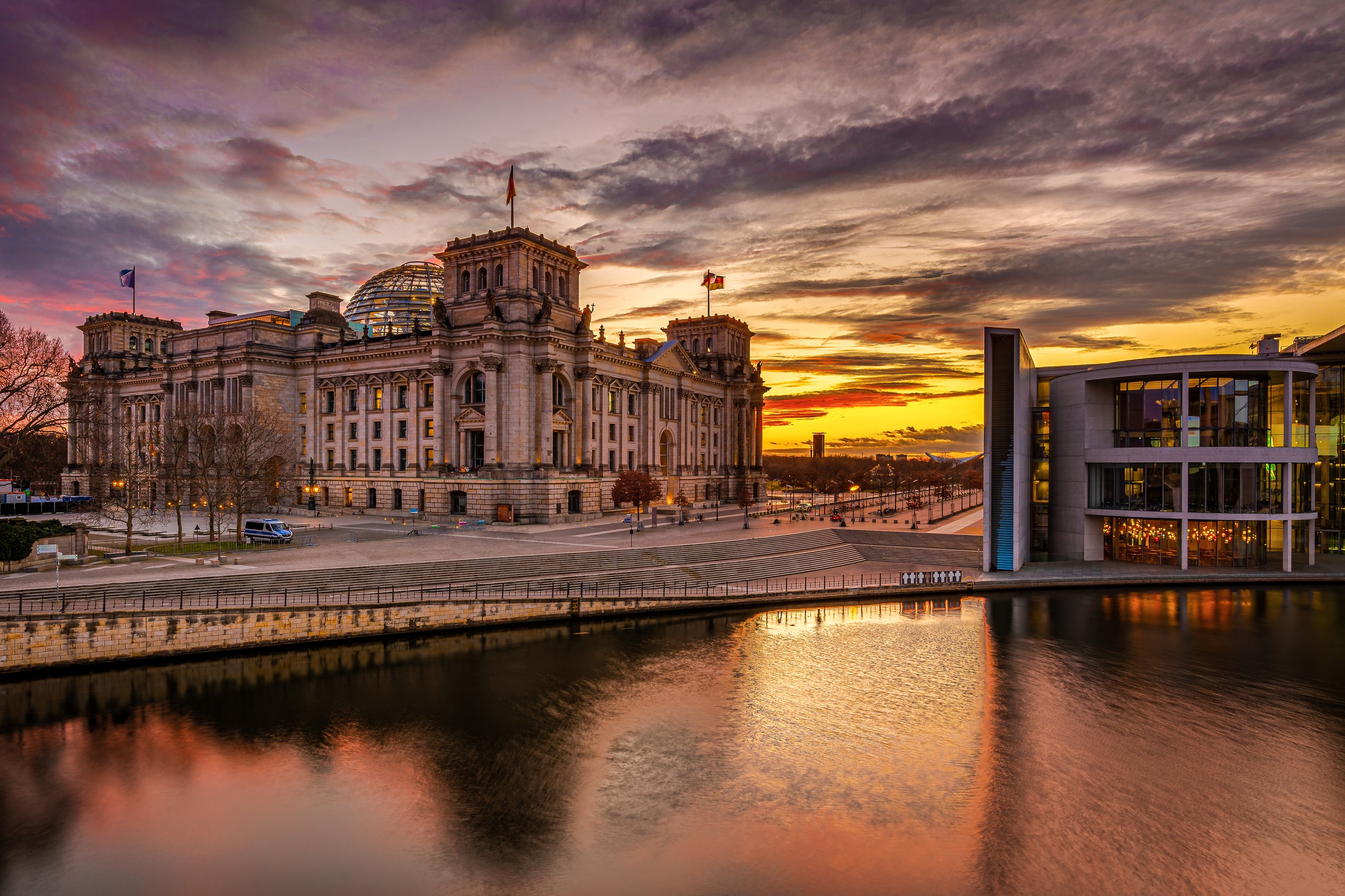
Where competing promises must become decisions — Berlin, 17 February 2020 (archive). The Reichstag and nearby parliamentary buildings beside the Spree at sunset. Germany’s federal parliament is the Bundestag, whose main chamber is in the Reichstag building. Photo: Michabka; CC BY-SA 4.0; original image.
Germany is governed by a coalition of the centre-right CDU/CSU and the centre-left SPD under Chancellor Friedrich Merz. Coalition government means parties negotiate a shared programme; a chancellor does not govern with presidential freedom. The current argument over spending and reform takes place inside that arrangement and across the federal, state and municipal levels. [46]
Confidence is weak. The October ARD-DeutschlandTrend, fielded on 28–30 September among 1,303 eligible voters, found 10% satisfied with the federal government. This is a dated national poll with sampling uncertainty, not a poll of the demonstrators. It establishes broad dissatisfaction at that moment, not a single cause or an inevitable election outcome. [26]
Young voters are divided too. The official representative statistics for the 2025 federal election show the socialist Left party, Die Linke, leading among voters aged up to 24 with 27.3%. The nationalist-right Alternative for Germany, or AfD, led among 25–34-year-olds with 20.8%. These groups do not map neatly onto the label “Gen Z”. Protest should not be read as a unified turn to either the left or the right. [27]
Demography makes the distributional conflict harder. Destatis projects that around one in four residents will be at least 67 by 2035, compared with one in five in 2024; that is a projection, not an observed outcome. Germany’s public pension system largely uses current contributions to finance current pensions. A rising retired population places pressure on contributions, taxes, retirement arrangements or benefits unless productivity and employment compensate. [44]
Working households already face a substantial gap between employer labour costs and take-home pay. The OECD’s 2026 report put Germany’s 2025 tax wedge at 49.3% for a single childless worker earning the average wage, compared with 35.1% across the OECD. That includes income tax and employer and employee social contributions. It is not a 49.3% income-tax rate or the burden on every young worker. [28]
This is not a simple contest between prosperous pensioners and deprived youth. Income, property, inheritance and region divide both groups. But older voters have greater numerical weight: people aged 60 and above represented 42.6% of the eligible electorate in 2025. A system that protects established entitlements while raising the cost of entry can look unresponsive even when each individual policy has a defensible purpose. [27]
More money is possible; delivery is harder
Germany’s debt brake is a constitutional constraint on borrowing. It has long shaped the country’s fiscal politics, but the rules changed in 2025. The state authorised a €500 billion special fund for infrastructure and climate neutrality, with investments eligible for approval over twelve years. It also created additional borrowing room for specified defence and security expenditure above 1% of GDP. The fund is an authorisation, not €500 billion already spent. [34,35]
That makes “Germany is simply imposing austerity” an incomplete description. Large federal commitments can coexist with pressure on local services, social-insurance finances or particular departments. Different levels of government carry different responsibilities. Money allocated in Berlin does not automatically create planners, construction workers or a functioning procurement process in a municipality.
KfW’s municipal research identifies obstacles beyond funding, including staffing, approval procedures and construction requirements. The test is not only whether the government can borrow, but whether it can turn authorised funds into usable schools, transport, housing and digital infrastructure. Delayed delivery risks deepening distrust because the public has already heard the promise. [14]
The same problem exists at European scale. Mario Draghi’s 2024 competitiveness report presentation estimated additional annual investment needs of €750–800 billion across the EU. That was an estimate involving public and private investment, not an approved European budget. It reflected the scale of the challenge in innovation, the energy transition and defence. [45]
The choices are not a fixed one-euro-for-one-euro contest between schools and soldiers: borrowing and stronger growth can expand resources, and some infrastructure serves civilian and military uses. But engineers, labour, materials and administrative capacity remain scarce. Governments must explain sequencing and distribution, not merely announce totals. For Europe, German political credibility depends partly on whether its fiscal expansion produces visible results at home and useful capacity beyond its borders.
Why military service makes the argument personal
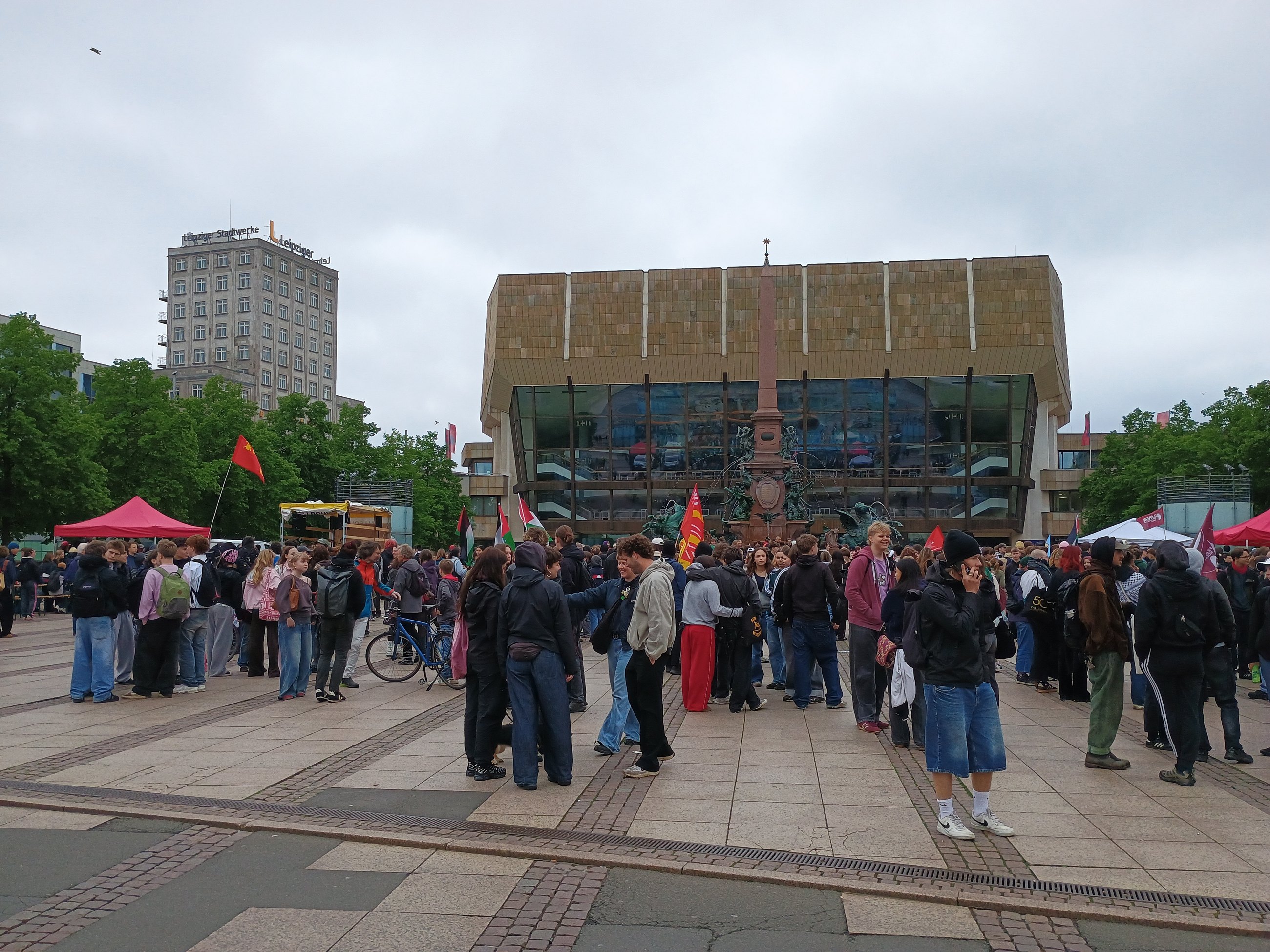
A generation debates the meaning of service — Leipzig, 8 May 2026 (archive). Students at a school strike against military service and conscription. This photograph records the May demonstration, not the protests of 31 October. Photo: Roy Zuo; CC BY-SA 4.0; original image.
The Bundeswehr is Germany’s armed forces; the Bundestag is its federal parliament. The distinction matters because the current service system contains compulsory administrative elements while retaining voluntary military service as its starting point. It is not a universal call-up already under way. [30,31]
Under the framework introduced in January 2026, questionnaires go to 18-year-old German citizens. Men must respond; women may respond voluntarily. Mandatory medical screening for men born in 2008 or later is scheduled from 1 July 2027. Activating needs-based compulsory service requires a further parliamentary law. A medical examination and an order to serve are different legal steps. [30,31]
That does not make young people’s concern imaginary. Registration and screening build the administrative capacity for a possible future call-up. A student or apprentice planning several years ahead has a legitimate interest in the conditions under which an obligation could interrupt education or work. Conditional policy can affect expectations before it affects legal duties.
The government’s argument is that equipment requires trained personnel and credible defence requires reserves. The objection is about autonomy, fairness and opportunity cost: whose plans are interrupted, how service is compensated, how exemptions work and whether interrupted education is protected. Those questions affect the legitimacy of a system as well as its military usefulness.
The European dimension is burden-sharing. Germany’s defence capacity contributes to an alliance whose members have different histories, military systems and perceptions of danger. For countries nearer Russia, deterrence can feel more immediate. For a young German asked to serve, the cost becomes intensely personal. Explaining that connection honestly is more persuasive than treating either anxiety or preparedness as self-evidently unreasonable.
- Questionnaire: Mandatory response for men; voluntary for women.
- Medical screening: Scheduled from 1 July 2027 for men born in 2008 or later.
- Military service: Voluntary starting model; screening is not an automatic call-up.
- Needs-based conscription: Requires a further Bundestag law.
Russia’s war: three different kinds of spillover
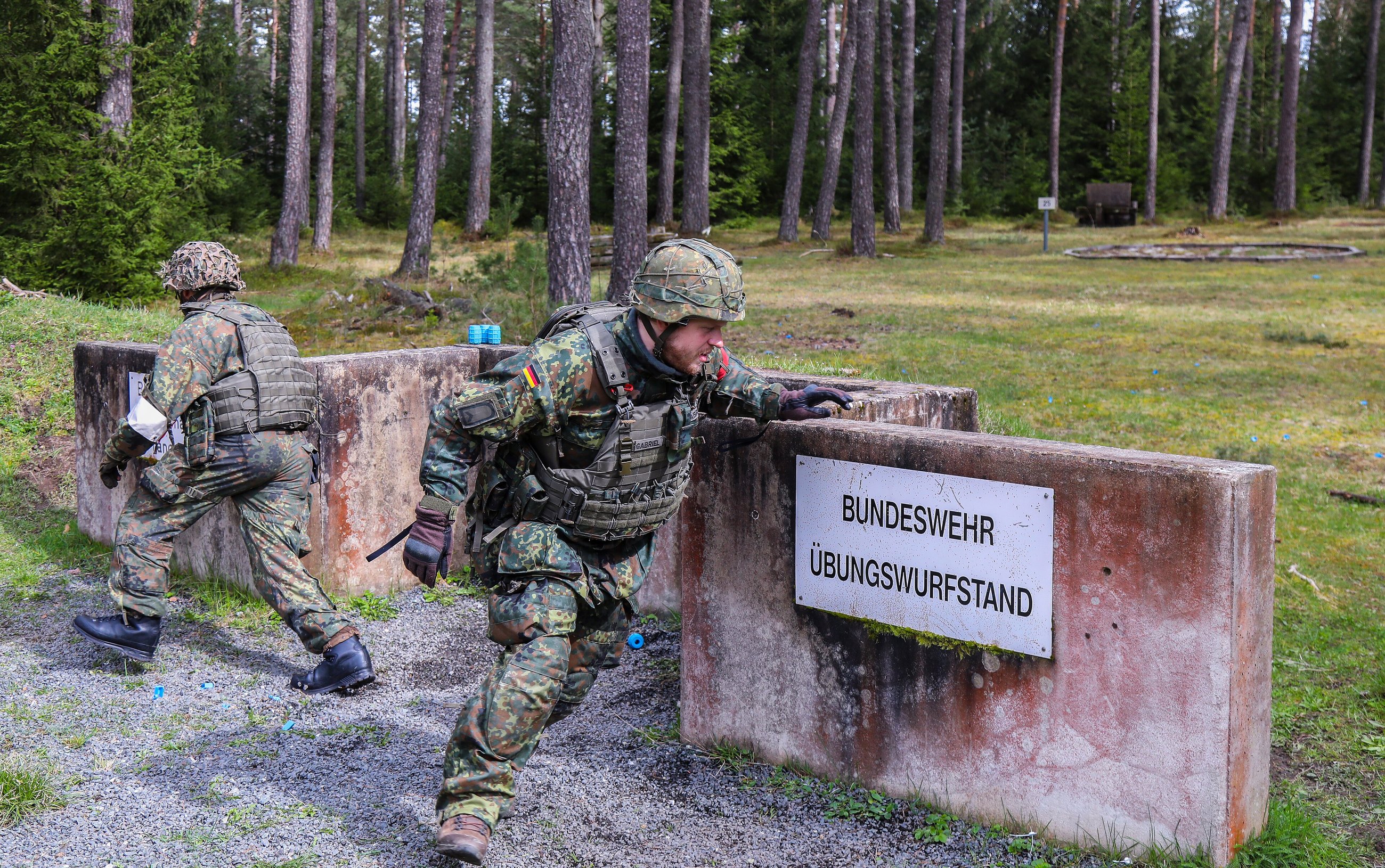
Preparedness is built through training — Grafenwöhr, Bavaria, 4 April 2024 (archive). Bundeswehr soldiers practise hand-grenade procedures at the Grafenwöhr Training Area. This is a training exercise in Germany, not combat in Ukraine or a photograph of new conscripts. Photo: Spc. Thomas Dixon / U.S. Army; U.S. public-domain work; original image.
The first spillover is economic and has already occurred: energy disruption, changed trade patterns and greater security spending. The second is hostile activity below the threshold of conventional war, including espionage, sabotage and cyber operations. The third is the possibility of a military confrontation involving NATO, whether through deliberate action or escalation from an incident. These risks should not be compressed into a prediction that war will inevitably spread.
At the Bundestag’s public intelligence hearing on 5 October 2026, German intelligence chiefs described Russia as a central security challenge and warned about both hybrid activity and the risk of violent conflict. These are official threat assessments. They justify serious examination of preparedness; they do not establish a date on which a wider war will begin. [32]
NATO’s Article 5 treats an armed attack on one ally as an attack on all. Each ally undertakes to assist with the action it considers necessary, which can include armed force. It is a collective-defence commitment, not an automatic instruction that every member must take an identical military action. Understanding that distinction helps separate treaty obligations from speculation about a future crisis. [47]
Germany’s ports, railways, roads and industrial capacity matter because it is a major logistical centre behind the alliance’s eastern flank. Readiness therefore involves more than weapons purchases. Reliable civilian infrastructure, repair capacity, communications and trained personnel also affect the ability to respond. The same railway can support daily economic life and military reinforcement.
The political challenge is to explain deterrence without making escalation sound inevitable. Supporters argue that credible capability reduces the chance an adversary tests the alliance. Critics question particular spending choices, escalation risks and the distribution of sacrifices. Those arguments require evidence and democratic scrutiny. Opposition to a service policy does not by itself imply support for Russia.
Nothing in the sources reviewed establishes that Russia organised the October demonstrations. Nor can a probability of wider war be inferred from a weekend of protest. The relevant questions are specific: what threat is being addressed, which capabilities are missing, what would trigger additional obligations, and how will leaders manage the risk of miscalculation?
What instability in Europe actually means
For a reader outside Europe, the mistake would be to convert Germany’s tensions into a single verdict on an entire continent. Countries have different industrial structures, housing markets, public finances and exposure to Russia. Spain’s stronger quarterly growth and Germany’s lower youth unemployment describe different dimensions of resilience. Neither statistic alone establishes which society is politically more secure. [9,39]
The more useful concept is overlapping pressure. Weak growth makes distribution harder. Expensive housing reduces mobility and independence. Ageing raises demands on welfare systems. Security threats increase the need for spending and personnel. Political fragmentation can make the resulting choices slower and less predictable. Each problem can worsen the others, even without a financial crash or a constitutional breakdown.
Three paths are plausible; they are scenarios, not forecasts. In a renewal scenario, investment improves infrastructure and productivity, transitions between jobs become easier, and defence commitments gain support because the burden is intelligible and fairly shared. In a prolonged-stagnation scenario, limited progress leaves households paying more for institutions that deliver less, strengthening parties that promise rupture. In a security-shock scenario, escalation forces faster choices on spending, readiness and public obligations than governments would otherwise make.
The indicators to watch are concrete: completed investment projects rather than announced funds; apprenticeship placements and recruitment rather than vacancies alone; rent relative to income rather than national inflation alone; productive private investment rather than confidence surveys alone; and transparent defence planning rather than alarming dates. Political trust matters, but so does whether decisions survive negotiation and produce results.
For businesses, workers and prospective residents elsewhere in Europe, the practical implication is to examine exposure by country, city and sector. A German industrial supplier, a Spanish service business and a student entering Munich’s housing market confront different risks. The relevant question is how a particular livelihood connects to energy, demand, public services and security—not whether “Europe” is safe or unstable in the abstract.
Germany’s protests matter because they test a proposition on which much of European stability rests: that democratic government can ask citizens to adapt while giving them a credible stake in the future. The country retains considerable resources to answer that test. Its challenge is to turn them into visible opportunity and legitimate shared obligations. What happens in Germany will not determine every European outcome, but it will help determine how much capacity and confidence Europe brings to the next crisis.
Research cut-off: 1 November 2026. Reporting on the protest weekend was still developing. The numbered sources below correspond to the references in the article. Maps, statistics and archive photographs retain their stated dates and qualifications.
Sources & further reading
- Financial Times: Gen Z protests turn violent in Germany1 Nov 2026
- Deutschlandfunk: Zehntausende bei bundesweiten Jugendprotesten - Ausschreitungen am Rande1 Nov 2026
- hessenschau / ARD: Ausschreitungen nach Gen-Z-Protest in Frankfurt31 Oct 2026
- AFP: German police, protesters clash after Gen Z demos31 Oct 2026
- Tagesschau: Weitgehend friedlich - in einigen Städten Ausschreitungen31 Oct 2026
- Euronews: Germany Gen Z protests turn violent as shops looted1 Nov 2026
- WEB.DE, Leon Kottmann: Wir sind kein Sparposten: So lief der Protest der Gen Z in München31 Oct 2026
- rbb / ARD: Berliner Polizei stellt sich für den 31. Oktober auf Großeinsatz ein30 Oct 2026
- Eurostat: Euro area unemployment at 6.5%30 Oct 2026; September data
- Bundesagentur für Arbeit: Arbeitsmarkt im Oktober 202630 Oct 2026
- Bundesagentur für Arbeit: Ausbildungsmarktbilanz 2025/2630 Oct 2026
- IW / MLP: MLP Studentenwohnreport 202630 Sep 2026
- Destatis: Inflationsrate im Oktober 2026 voraussichtlich +2,8%30 Oct 2026
- KfW / Difu: KfW-Kommunalpanel 20262026 edition
- Destatis: Bruttoinlandsprodukt im 3. Quartal 2026 um 0,2% höher als im Vorquartal30 Oct 2026
- Destatis: Bruttoinlandsprodukt im Jahr 2025 um 0,2% gewachsen15 Jan 2026
- ifo Institut: ifo Geschäftsklimaindex gestiegen26 Oct 2026
- Bloomberg, Mark Schroers / The Edge: Germany's business outlook in October unexpectedly improves for sixth month26 Oct 2026
- BDI: De-Risking statt Entkopplung: Europa muss der Balanceakt gelingen9 Sep 2026
- Volkswagen Group: Agreement reached: Volkswagen AG positions itself competitively for the future20 Dec 2024
- BASF: A flagship for chemical production: BASF inaugurates world-scale Verbund site in China26 Mar 2026
- Destatis: Strom- und Gaspreise für Haushalte im 1. Halbjahr 2026 gesunken30 Sep 2026
- BDEW: Strompreisanalyse Herbst 202621 Aug 2026 edition
- Federal Economy Ministry: Industriestrompreis wird eingeführt16 Apr 2026
- Federal Economy Ministry: Wettbewerbsfähige Strompreise - Industriestrompreis entlastet die IndustrieJun 2026
- Infratest dimap / ARD: ARD-DeutschlandTrend Oktober 2026Fieldwork 28-30 Sep 2026
- Federal Returning Officer: Bundestagswahl 2025: Ergebnisse der repräsentativen Wahlstatistik23 Jun 2025
- OECD: Taxing Wages 20262026; tax year 2025
- Shell youth study: 19. Shell Jugendstudie: Informationsmaterial2024
- Federal Government: Neuer attraktiver Wehrdienst beschlossen19 Dec 2025; accessed 1 Nov 2026
- Federal law / Deutsche Rentenversicherung: Section 2a WPflG: Anordnung der Bedarfswehrpflicht durch GesetzEffective 1 Jan 2026
- Deutscher Bundestag: Nachrichtendienste sehen Russland als gefährlichsten Gegner5 Oct 2026
- NATO: Deterrence and defenceAccessed 1 Nov 2026
- Federal Finance Ministry: Fragen und Antworten zum Sondervermögen für Infrastruktur und Klimaneutralität4 Sep 2026
- Federal Finance Ministry: Sollbericht 2026: Bundeshaushalt, KTF und SVIKFeb 2026
- ARD / hessenschau: Gen-Z-Proteste in Hessen31 Oct 2026
- Natural Earth: Admin 0 countries, 1:50m; populated places, 1:10mDataset accessed 1 Nov 2026
- Eurostat: Key figures on Europe 2026, GDP shares in 20252026 edition
- Eurostat: GDP up by 0.4% in the euro area and by 0.5% in the EU, Q3 2026 flash estimate30 Oct 2026
- European Commission: Country Report Germany 20262026
- European Central Bank: China competition and uneven exposure across the euro areaEconomic Bulletin 6/2026
- European Central Bank: The impact of global value chains on the euro area economyEconomic Bulletin 6/2020
- Council of the European Union: UnanimityAccessed 1 Nov 2026
- Destatis: Jede vierte Person ist 2035 im Rentenalter11 Dec 2025
- Mario Draghi: Address at the presentation of the report on the future of European competitiveness9 Sep 2024
- German federal government: Schwerpunkte des Koalitionsvertrags2025 coalition agreement; accessed 1 Nov 2026
- NATO: Collective defence and Article 5Accessed 1 Nov 2026
- German federal government: Fragen und Antworten zur EnergieversorgungAccessed 1 Nov 2026
- German federal government: Speech by economy minister Robert Habeck, historical Russian gas dependence2023